
Michelangelo's Paintings at the Accademia Gallery
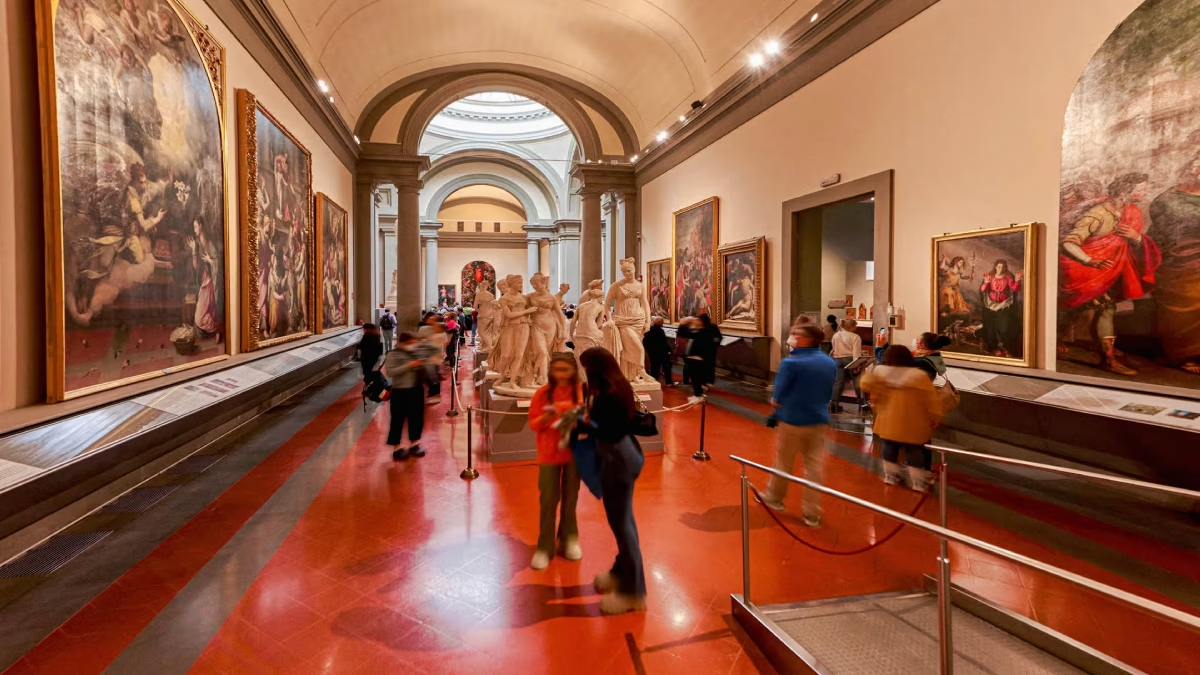
The Accademia Gallery holds the world’s largest collection of Michelangelo’s sculptures in one location. This includes David, the four Prisoners, St. Matthew, and the Palestrina Pietà (whose attribution to Michelangelo is disputed). There are no confirmed paintings by Michelangelo at the Accademia — he is represented here entirely by sculpture. The gallery does however hold paintings by contemporaries directly influenced by him, and the collection context enriches the Michelangelo experience considerably.
A note on the article title: visitors searching for “Michelangelo paintings Accademia Gallery” are usually looking for a full account of what Michelangelo made that can be seen in Florence’s Accademia. This guide covers exactly that — all the Michelangelo works in the gallery — while being honest that the Accademia’s Michelangelo collection is entirely sculptural.
Does the Accademia Gallery Have Michelangelo Paintings?
No — and the question itself reveals something interesting about Michelangelo’s reputation. He is so central to the Renaissance that visitors assume his work must be everywhere, including paintings. In fact, Michelangelo considered himself primarily a sculptor and accepted painting commissions reluctantly. His two major painting projects — the Sistine Chapel ceiling (1508–1512) and the Last Judgement (1536–1541) — are both in the Vatican. His only completed panel painting, the Doni Tondo, is in the Uffizi Gallery in Florence.
The Accademia holds no confirmed Michelangelo paintings. What it holds, more abundantly than any other museum in the world, is Michelangelo’s sculpture.
The Michelangelo Sculptures at the Accademia Gallery
1. Michelangelo’s David (Tribune, 1501–1504)
The centrepiece of the Accademia collection and the primary reason most visitors come to the museum. A 5.17-metre marble statue of the biblical David, carved from a single damaged block of Carrara marble over two years and eight months by a 26-year-old sculptor who had already completed the Vatican Pietà.
David represents the moment before the battle — not the triumphant aftermath shown by every previous Florentine sculptor who had tackled the subject. David stands in contrapposto, sling over his shoulder, stone in his right hand, gaze fixed on the approaching Goliath. The head and hands are deliberately oversized, designed for the statue’s original intended position on a cathedral rooftop 80 metres above ground.
For the full account of David’s commission, technical achievement, political symbolism, and conservation history, see our dedicated Michelangelo's David guide.
Location: Tribune, at the end of the main gallery corridor Date: 1501–1504 Material: Carrara marble Dimensions: 5.17 metres high
2. The Four Prisoners (Galleria dei Prigioni, c. 1519–1534)
Four large unfinished male figures in various stages of emergence from raw marble blocks, displayed in the long corridor leading to David. Carved for successive versions of the planned tomb of Pope Julius II — a commission that occupied (and tormented) Michelangelo from 1505 until 1545 — they were donated to the Medici after Michelangelo’s death, placed in the Boboli Gardens, and transferred to the Accademia in 1908.
The four figures are known as the Awakening Slave, the Young Slave, the Bearded Slave, and the Atlas Slave. Two more Prisoners from the same project — the Dying Slave and the Rebellious Slave, both more nearly complete — are in the Louvre in Paris.
The Prisoners are among the most philosophically rich works in the Accademia collection. Their unfinished state has generated centuries of debate: were they left incomplete by circumstance, or did Michelangelo deliberately leave them in a state that expressed his deepest theme — the soul’s struggle to free itself from the prison of matter? Both readings have serious scholarly support.
For the full account of the Prisoners’ history, Neoplatonic context, and what to look for in each figure, see our dedicated Prisoners guide.
Location: Galleria dei Prigioni (Hall of the Prisoners), the corridor leading to David Date: c. 1519–1534 Material: Carrara marble Dimensions: approximately 2.7–2.8 metres each
3. St. Matthew (Galleria dei Prigioni, c. 1503–1505)
St. Matthew is displayed alongside the Prisoners but belongs to a different commission — begun in 1503 as the first of a planned series of twelve Apostles for Florence Cathedral’s façade. Like the Prisoners, it was abandoned when Michelangelo was called to Rome for the Julius II tomb. Unlike the Prisoners, it predates that commission by two years.
The figure is exceptional as an example of Michelangelo’s method. The front of the torso is worked to a level of anatomical precision and muscular expressiveness that rivals the Prisoners at their most advanced; the reverse of the figure remains the raw surface of the marble block, almost untouched. This asymmetry is the most direct illustration available anywhere of Michelangelo’s technique of carving from the front face of the block inward — liberating the figure from one surface while leaving the opposing face as he found it.
The twisting movement of St. Matthew — the body in a complex serpentine turn, the head inclined, the limbs pulling in opposing directions — anticipates the Mannerist style of the mid-16th century, well before it was otherwise established. It is a figure worth spending time with independently of its famous neighbours.
Location: Galleria dei Prigioni, alongside the Prisoners Date: c. 1503–1505 Material: Carrara marble Dimensions: approximately 2.7 metres
4. The Palestrina Pietà (Galleria dei Prigioni, c. 1555 — attribution disputed)
The Palestrina Pietà is displayed in the Galleria dei Prigioni alongside the confirmed Michelangelo works, but its attribution to Michelangelo is significantly disputed and should be understood as such.
The work shows three figures: the dead Christ, supported by the Virgin Mary and another figure (possibly St. John or Joseph of Arimathea). The sculpture was in the Barberini family chapel in Palestrina, a town near Rome, before its acquisition by the Italian state in 1939. The attribution to Michelangelo was first made in the 18th century without documentary support.
Current scholarship inclines toward attributing the work to another hand — possibly Niccolò Menghini, a follower of Michelangelo active in Rome — or to a workshop that completed a figure Michelangelo may have begun. The Galleria dell’Accademia’s own description notes that “the attribution to the master is still somehow controversial.” The musculature of Christ is broadly consistent with Michelangelo’s late style; the composition and finish of other sections are less so.
The Palestrina Pietà is worth seeing as a work in its own right — it is a powerful and emotionally direct sculpture — but visitors should be aware that attributing it to Michelangelo is a minority position in current art historical scholarship.
Location: Galleria dei Prigioni Date: c. 1555 (attributed) Material: Marble Dimensions: approximately 2.5 metres
The Michelangelo Collection in Context
Why the Accademia Has So Much Michelangelo
The concentration of Michelangelo’s sculpture at the Accademia is not accidental. When David was moved from Piazza della Signoria to the museum in 1873, the original intention was to create what was described as a “Michelangelo museum” — a dedicated space celebrating the sculptor’s work on the occasion of the 400th anniversary of his birth. The Prisoners were brought from the Boboli Gardens in 1908 as part of this same curatorial vision.
The result is a collection that, while smaller in number of works than the Vatican or the Bargello, concentrates Michelangelo’s sculptural career across three distinct phases: early maturity (David, St. Matthew, 1501–1504), the long middle period of the Julius II tomb (Prisoners, c. 1519–1534), and the contested late work (Palestrina Pietà, c. 1555).
What the Accademia Does Not Have
The Doni Tondo (Uffizi Gallery): Michelangelo’s only completed panel painting, showing the Holy Family in a circular format. Made for Agnolo Doni around 1504–1506, shortly after David. In the Uffizi Gallery, a 15-minute walk from the Accademia.
The Bacchus (Bargello National Museum): Michelangelo’s early marble Bacchus, carved 1496–1497 in Rome, his first major free-standing sculpture. Now in the Bargello, a 12-minute walk from the Accademia. The new 2026 combined ticket (€26, 48-hour validity) covers both the Accademia and the Bargello.
The Medici Tombs (Medici Chapels, San Lorenzo): The New Sacristy designed by Michelangelo, housing the tombs of Lorenzo de’ Medici and Giuliano de’ Medici with the famous figures of Day, Night, Dawn, and Dusk. Also in Florence, in the Medici Chapels attached to the Basilica of San Lorenzo.
The Bandini Pietà (Museo dell’Opera del Duomo): A large Pietà carved by Michelangelo for his own tomb, later mutilated by him and left unfinished. In the Museo dell’Opera del Duomo opposite the Florence Cathedral.
Paintings Responding to Michelangelo’s Sculpture
While the Accademia holds no Michelangelo paintings, its painting collection contains several works where the influence of his sculpture is directly visible. The gallery’s 16th-century Florentine paintings — particularly works by Pontormo, Bronzino, and Fra Bartolomeo — show the impact of David and the Sistine Chapel on Florentine painters working in Michelangelo’s shadow.
The Hall of the Colossus, the first major room visitors enter, contains Florentine paintings from the early 16th century — Perugino, Filippino Lippi, Fra Bartolomeo — that represent the generation Michelangelo was working alongside when he carved David. Seeing these paintings immediately before encountering David’s formal resolution clarifies how extraordinary the statue’s achievement was in its historical moment.
Visiting Michelangelo at the Accademia: Practical Advice
The route: Enter the museum, pass through the Hall of the Colossus, and follow the main corridor (the Galleria dei Prigioni) all the way to the Tribune. The Prisoners line both sides of this corridor; St. Matthew and the Palestrina Pietà are also displayed here. David waits at the end.
Recommended time: 45–60 minutes focused entirely on the Michelangelo works. For the full collection including the musical instruments and paintings, allow 90 minutes to 2 hours.
Best approach: Walk past the Prisoners on the way to David, then return to spend time with them individually on the way back. The Prisoners reward attention that the pull of David tends to preclude on the initial approach.
With a guide: Guided tours typically cover all the Michelangelo works with 60–90 minutes of commentary. The account of the Julius II tomb commission — and how it connects David, the Prisoners, and the atmosphere of Michelangelo’s career — is one of the most compelling narratives in Renaissance art history, and best understood through a guide who can tell it in place. See our guided tours guide.
Frequently Asked Questions
Are there Michelangelo paintings at the Accademia Gallery?
No. The Accademia holds Michelangelo’s sculpture, not his paintings. His only completed panel painting, the Doni Tondo, is in the Uffizi Gallery. The Accademia is the world’s most important single location for Michelangelo’s sculpture.
Is the Palestrina Pietà definitely by Michelangelo?
The attribution is contested. Current scholarly opinion leans toward it being by another hand — possibly Niccolò Menghini — though the gallery continues to display it as part of the Michelangelo collection with the note that attribution “remains somewhat controversial.”
Where can I see more Michelangelo work in Florence?
The Bargello National Museum holds the early Bacchus and the Madonna of the Stairs (bas-relief). The Medici Chapels have the New Sacristy with Day, Night, Dawn, and Dusk. The Museo dell’Opera del Duomo holds the Bandini Pietà. The Uffizi holds the Doni Tondo.
Does the Accademia have Michelangelo drawings?
No. Michelangelo drawings are held primarily in the Casa Buonarroti (the family house, now a small museum, a 10-minute walk from the Accademia) and in major collections outside Florence. —
