
Accademia Gallery with Kids: A Family Visitor's Guide
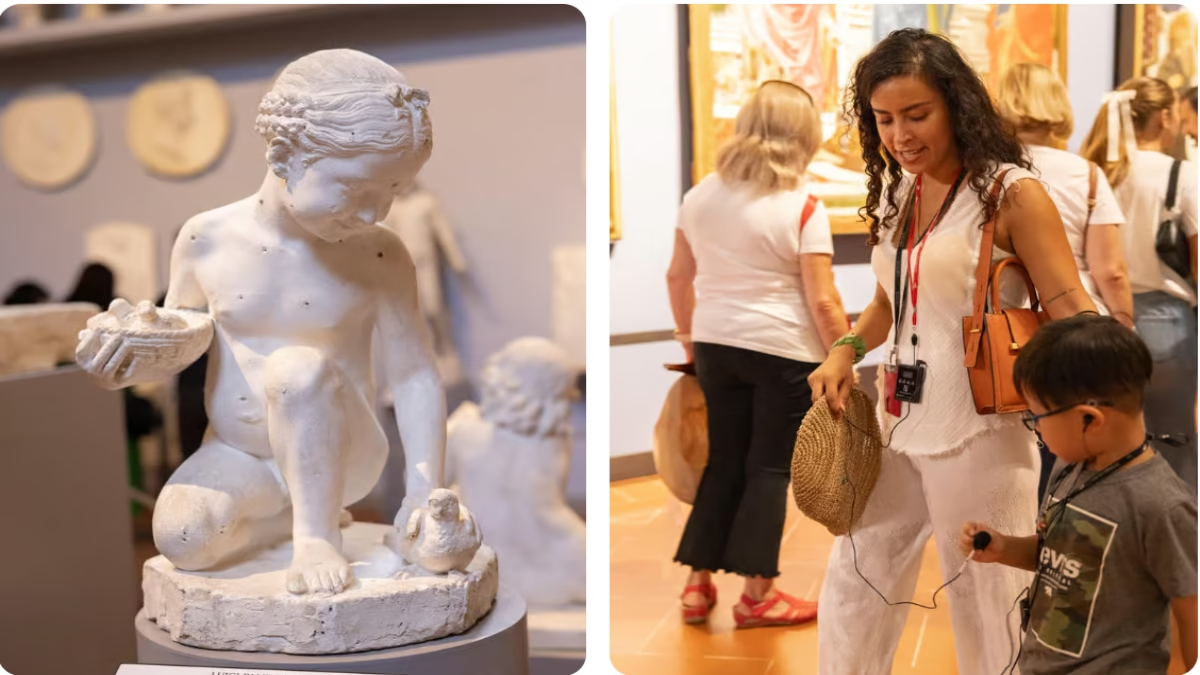
The Accademia Gallery works well for families because David is genuinely awe-inspiring at any age — the sheer scale of a 5.17-metre marble figure affects children viscerally, often before they have any context for why. Children under 18 enter free of any nationality. Allow 45 minutes for younger children focused on David and the Prisoners; up to 90 minutes if adding the musical instruments. A private tour with a family-specialist guide transforms the visit from a queue to see a famous statue into an experience children remember.
Many parents approach the Accademia Gallery with uncertainty. It is a museum with a reputation for crowds, and most of what it contains is technically adult cultural content. But David works differently from most artworks. A 5.17-metre man carved from a single block of marble, standing in a room built specifically to hold him, is something that registers immediately for children who could not name another work of Renaissance art. You do not need to explain its importance. The scale explains itself.
This guide covers everything families need to know: what works for different ages, how to prepare children, which ticket option gives the best family experience, and the practical details that make a visit with children smooth rather than stressful.
Is the Accademia Gallery Worth It with Kids?
For most families: yes, briefly. David is the rare museum attraction that works across age groups because it operates primarily through scale and presence rather than conceptual understanding. The Prisoners corridor is genuinely fascinating for older children — figures half-emerged from raw marble, like a puzzle the sculptor left unsolved. The musical instruments section, with the world’s oldest piano, is a quieter surprise.
The honest caveats: the museum is compact and linear, which means there is little room for children to move around or explore independently. On busy days the Tribune around David is dense. The Byzantine painting galleries and much of the fine art collection require more background to appreciate. For families with very young children (under 4), this is a brief, focused visit — not an afternoon.
The Accademia Gallery is better than the Uffizi for most families because it is smaller, faster, and anchored by a single attraction that needs no explanation. The Uffizi is overwhelming for young children; the Accademia is manageable.
By Age: What to Expect
Under 4 years David makes an impression even at this age — the scale is undeniable, and children this age respond to size. But 45 minutes is the realistic ceiling before patience runs out. Bring the family carrier or a compact stroller (lifts are available). The museum is accessible but narrow corridors in peak season can make stroller navigation frustrating. Focus entirely on David and exit. No need to attempt the upper floor or paintings.
Ages 4–7 This age range benefits enormously from preparation (see below). With context — even just the story of David and Goliath and the idea that a real person carved this from a rock — children this age can be genuinely engaged for 45–60 minutes. The Prisoners are compelling: figures that look like they are trying to get out of the stone. The musical instruments room has interactive elements that this age group enjoys.
Ages 8–12 The sweet spot for the Accademia with children. Old enough to appreciate the craft and historical context, young enough to be genuinely awestruck by scale. The private tour option is particularly effective here — a good guide frames the David story as a series of compelling problems: the abandoned marble block, the failed attempts by other sculptors, Michelangelo’s solution, the secret of the oversized hands. This age group asks good questions.
Ages 13+ Teenagers often appreciate the Accademia more than younger children, particularly those with any interest in art, history, or craft. The non-finito idea — Michelangelo’s unfinished works as a deliberate aesthetic choice — is genuinely interesting for adolescents who engage with ideas. The audio guide option works well for this age; they can navigate at their own pace.
What Captivates Children Most
Michelangelo’s David — the scale The most consistent child reaction is surprise at the size. Parents who have seen photographs prepare children intellectually, but the in-person experience of standing beside a 5.17-metre figure in a room built around it is different from any image. David is as tall as an adult giraffe and weighs over 5.5 tonnes. That number becomes vivid in front of the statue.
The deliberate details for children to find: – David’s hands are disproportionately large — this was intentional, designed for a figure originally planned for a cathedral rooftop where viewers would look up – The right hand shows a visible vein; Michelangelo worked this in detail for a figure that was never meant to be seen at eye level – The eyes do not look at you when you stand directly in front — David looks slightly to the side, watching for Goliath – The chisel marks are still visible on the unfinished base
The Prisoners — figures escaping from stone The four Prisoners in the corridor leading to David are often more interesting for children than David himself, because the unfinished state is dramatic and immediate. You can see where Michelangelo stopped. The figures appear to be struggling to get out. Some experts suggest this was intentional; others that circumstances intervened. Either explanation is compelling for children who like mystery.
The Musical Instruments — the world’s oldest piano The Museum of Musical Instruments on the upper floor is consistently undervisited and consistently quiet. The Cristofori fortepiano of 1700 — the oldest surviving piano in the world — was invented in Florence. Bartolomeo Cristofori worked for the Medici family, and the instrument in the Accademia was one of his first. For any child who plays piano or music, this is a direct connection to the origin of their instrument.
The three Stradivarius pieces in the collection are also extraordinary context for children who have heard the name but cannot visualise the object.
How to Prepare Children Before the Visit
Preparation is the single biggest factor in whether a family visit to the Accademia Gallery succeeds. Children who arrive knowing the story of David and Goliath, who have seen a photograph of the statue, and who have one or two things they are specifically curious about are ready to engage. Children who arrive cold in a crowded queue are not.
Tell the David and Goliath story beforehand. Any version works. The biblical underdog narrative — the small shepherd boy defeating the armoured giant with a sling and a stone — is universally compelling for children. Michelangelo depicts David before the fight, concentrating, the sling in his hand, watching Goliath approach. This is a statue of courage, not triumph.
Show them a photograph and compare the scale. Point out that David is as tall as your house. Ask them to guess how much he weighs (5.5 tonnes — as heavy as an elephant). The scale becomes personal before they see it.
Tell the marble story. There was a large block of marble sitting in the courtyard of Florence Cathedral for over 30 years. It had been damaged and abandoned by other sculptors who could not figure out what to do with it. Michelangelo asked for it, and spent three years carving David from this rejected block. Children find it extraordinary that the most famous statue in the world came from a piece of marble everyone else had given up on.
The hands puzzle. Ask your children to notice whether David’s hands look the right size. They are deliberately oversized — because Michelangelo originally designed the statue to stand on a cathedral roof, where viewers looking up from far below would need extra-large hands to read the gesture correctly. Even though the statue ended up at eye level in a piazza, Michelangelo kept the hands as designed. Children enjoy finding this once they know to look.
The Best Ticket Option for Families
Private tour — the clear recommendation for families with children A private licensed guide for your group only is the best family option for one reason above all others: the guide shapes the entire experience around your children’s ages and engagement level. They can spend twenty minutes on the marble story if that is what captivates your children. They can answer the question about the hands. They can make the Prisoners into a detective puzzle.
Standard group tours have up to 19 people. The guide cannot adapt to your children’s pace or interest level, and children in a group are not prioritised. A private tour costs €120–€190 for the group — for a family of four, that is €30–€47 per adult-equivalent, only moderately more than a standard group tour.
Self-guided entry with pre-prepared notes A good second option for families with older children (10+) who are comfortable following their own interests. Prepare by reading the David and Prisoners sections of our What To See articles beforehand. Give children specific things to look for. Let them lead.
Standard group tour — less ideal for families with young children Group tours work well for adults and older teenagers. For younger children, the pace and group format is often mismatched to how children engage with art. Unless your children are mature and interested, the private option is worth the premium.
2026 Family Educational Programmes
The Galleria dell’Accademia di Firenze offers dedicated educational activities for families, particularly from March to June 2026. These include:
- Stories of Games from the Past — workshops on Saturday mornings for children and families exploring daily life through objects in the collections (April 11 and June 13, 2026, at 10:30 am). Free with reservation at ga-afi-mn-bar.didattica@cultura.gov.it.
- The Art of Drawing — life drawing introduction workshop for families (March 28, 2026, at 10:30 am)
- Additional workshops and activities announced throughout the year
Check the official gallery website (galleriaaccademiafirenze.it) for current family programming.
Practical Tips for Visiting with Children
Book the earliest slot. The 8:15 am opening is consistently the least crowded period of the day. The Tribune is calmer, David is less surrounded, and children move through the space more easily. Getting there before tour groups arrive makes the experience significantly more pleasant.
Keep it short. The Accademia is a one- or two-highlight museum for young children. David and the Prisoners take 30–45 minutes. The musical instruments add 15 minutes. Forty-five to sixty minutes total is the sweet spot for children under 8. Do not attempt to see everything — exit while energy is still positive.
Children under 18 enter free. All state museums in Italy, including the Accademia Gallery, offer free entry for under-18s of any nationality. Book online to reserve a timed slot (the €4 booking fee applies per ticket, including free children’s tickets). Bring valid ID proving each child’s age at entry.
Strollers are allowed. The museum is accessible with lifts between floors. However, the corridors can be narrow and crowded in peak season. A compact stroller or baby carrier is more manageable than a large pram.
No food inside. The museum has no café and food is not permitted inside. Plan a gelato or café stop immediately after — this works as a motivating reward and a natural transition out of museum mode. The area around Piazza San Marco has several options within 3 minutes’ walk. See our restaurants and cafés guide.
Piazza San Marco after the visit. Directly adjacent to the museum, the square has open space for children to move after being still inside. The Convent of San Marco opposite (Fra Angelico’s frescoes) is a genuinely beautiful follow-up for older children and teenagers with an art interest — quieter and less crowded than the Accademia.
Frequently Asked Questions
What age is the Accademia Gallery suitable for?
Any age can visit — children of all ages are permitted. For toddlers and under 4s, keep the visit short (30–45 minutes, David and out). Ages 4–12 benefit most from preparation beforehand. Teenagers with any cultural interest find it genuinely worthwhile.
Is the Accademia Gallery better than the Uffizi for families?
For most families with children under 12, yes. The Accademia is smaller, faster, and built around a single extraordinary attraction that needs no explanation. The Uffizi requires more time, more context, and more patience — better suited to teenagers and adults.
Do children need their own timed entry ticket?
Yes — even free tickets for children under 18 require a reserved time slot when booking online. Add the appropriate number of child tickets to your booking. Bring ID proving age at entry.
Can I bring a pushchair/stroller?
Yes. The museum has lifts and ramp access. Compact pushchairs are more practical than large prams given the corridor widths during busy periods.
Is the Accademia Gallery educational enough to justify the visit for school-age children?
Strongly yes, with preparation. The Accademia touches multiple areas of school curriculum: Renaissance history, Italian geography, the concept of civic symbolism in art, the physical chemistry of marble carving, and the history of the piano (the instrument was invented in Florence). A 45-minute visit with context can anchor a week’s worth of learning conversations. —
