
Is the Accademia Gallery Worth It? An Honest Review
Yes — for one specific reason. Michelangelo’s David is the most extraordinary thing most visitors will see in a museum in their lifetimes, and the Accademia is the only place in the world where you can stand in front of it. The rest of the collection — the Prisoners, the musical instruments, the Florentine paintings — is genuinely good but not the reason to go. The €20 admission and 60–90 minutes of your time are well spent. The crowds are the main downside, and they are manageable with the right timing.
The Accademia Gallery generates more “is it worth it?” searches than almost any other Florence attraction. The reason is predictable: it is a small museum with a €20 entry fee and a queue. The obvious question is whether it delivers enough beyond the one famous statue to justify both.
This article gives a direct, honest answer. Not a generic “Florence is wonderful” endorsement, but a clear-eyed assessment of what you actually get for your ticket and your time.
What You Actually Get for €20
Michelangelo’s David The headline attraction, and the reason the question of “worth it” arises at all. David is 5.17 metres tall — roughly the height of a two-storey house — carved from a single block of Carrara marble between 1501 and 1504 by a 26-year-old artist working from a damaged block that two previous sculptors had abandoned. It has stood in its purpose-built Tribune since 1873, under a domed skylight that distributes natural light across the marble’s surface. There is a copy in the piazza outside. There is another on a hill above the city. Neither prepares you for the original. The scale becomes physically present in a way that photographs — however good — do not communicate. Whether you have studied the Renaissance or have never thought about it before, standing in front of David at close range produces a clear, uncomplicated response: this is extraordinary.
The Prisoners Four unfinished sculptures by Michelangelo line the corridor leading to David. The figures twist out of partially-worked marble blocks, incomplete by varying degrees — one almost fully emerged, another still half-submerged. They were carved for the tomb of Pope Julius II and abandoned when Michelangelo was redirected to the Sistine Chapel. The unfinished quality, rather than diminishing them, reveals something about the carving process that finished works conceal: the point chisel marks, the gradina tool traces, the negotiation between the sculptor’s intention and the marble’s resistance. For many visitors, the Prisoners are more interesting than David himself.
St. Matthew A single Apostle begun for Florence Cathedral’s façade and left unfinished when Michelangelo received the Julius II commission. Less famous than the Prisoners, less visited, and quiet enough in the gallery that you can stand in front of it as long as you like.
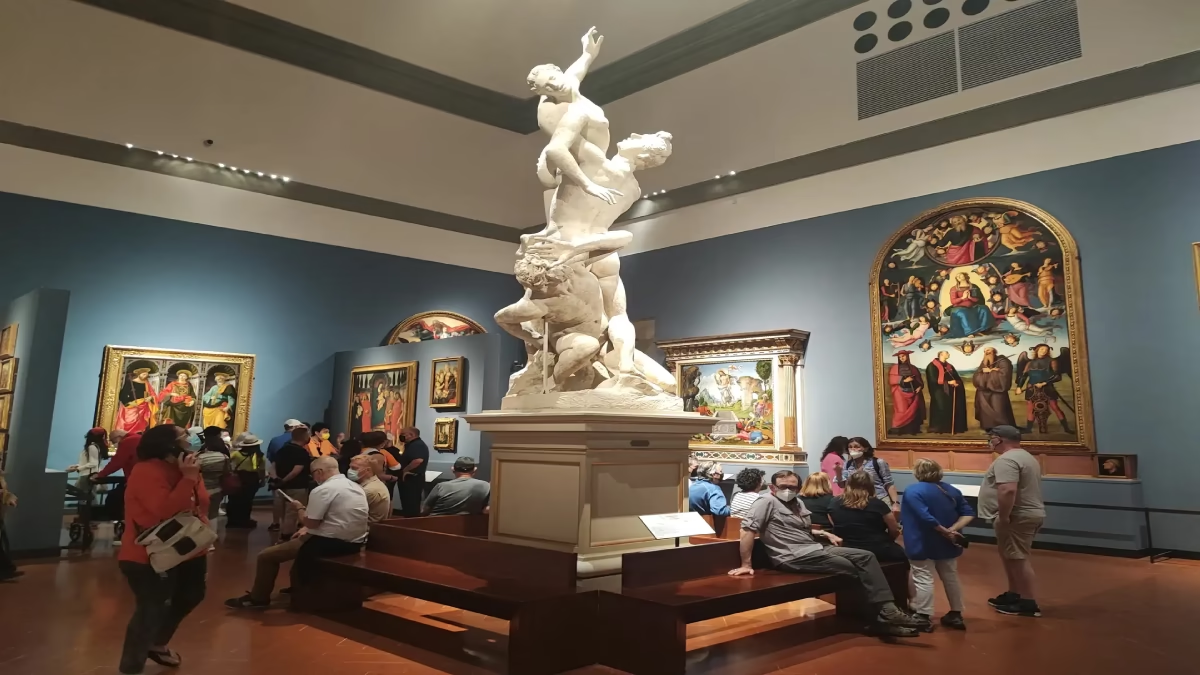
Hall of the Colossus The first major room houses a collection of early 16th-century Florentine paintings — Perugino, Filippino Lippi, Fra Bartolomeo, Botticelli — that would be headline works in a lesser museum. Most visitors walk through without looking. The room also contains Giambologna’s full-scale plaster model for the Rape of the Sabines, the marble version of which stands in the Loggia dei Lanzi outside the Uffizi. Seeing how a sculptor works out a complex multi-figure composition in plaster before executing it in stone is genuinely illuminating.
Museum of Musical Instruments The upper floor contains one of Europe’s finest collections of historic instruments from the Medici court. The centrepiece is the Cristofori fortepiano of 1700 — the oldest surviving piano in the world, made in Florence by the man who invented the instrument. Three Stradivarius pieces, a Nicola Amati violin, and dozens of other instruments from the 17th to 19th centuries sit in rooms that are almost always quieter than the ground floor. For anyone with an interest in music history, this is remarkable.
Byzantine and Gothic Painting Collection The largest collection of gold-ground panel paintings in Italy, covering three centuries of Florentine religious painting from the 13th to 15th centuries. Often passed by entirely, occasionally visited by art historians. It is very good if you engage with it; it requires no engagement if you do not.
What the Accademia Gallery Is Not
It is not the Uffizi. The Uffizi is one of the great encyclopaedic art collections in the world — 45 rooms of Renaissance painting across three centuries, covering Botticelli, Leonardo, Michelangelo, Raphael, Titian, and Caravaggio in depth. The Accademia is a focused museum built around a single artist and a handful of specific works. If you are choosing between the two and can only do one, the Uffizi gives more breadth. But David gives something the Uffizi cannot.
It is not uncrowded. At peak times, the Tribune around David is dense. You will not always be able to walk directly up to the statue and stand alone in front of it. With the right timing — the 8:15 am slot, or after 5:00 pm, or in low season — the experience is far quieter than the reputation suggests. At the wrong time, it is a scrum.
It is not large. The main collection is concentrated in a handful of rooms and can be covered thoroughly in 90 minutes. Visitors expecting a long afternoon in a sprawling complex will be surprised by how quickly they have seen everything.
The Honest Case For and Against
For visiting: David alone justifies the ticket. It is one of the two or three objects in Italian museums — alongside the Sistine Chapel ceiling and Botticelli’s Birth of Venus — that deliver on the years of seeing them in photographs. The Prisoners are a genuine bonus. The musical instruments are a remarkable and underappreciated surprise. At €20 and 90 minutes, the value ratio is high.
Against visiting (or arguments for lower expectations): If you are visiting Florence for one day and can only choose one major museum, the Uffizi covers more ground. If you have been to Florence before and have already seen David, the collection around it does not provide strong reason to return. If you visit during peak midday crowds in summer without a plan for managing the queue, the experience can be frustrating.
The crowd problem in context: The Accademia’s reputation for crowds is earned, but partly overstated. It applies most strongly to the Tribune in peak season at midday. The security queue takes 15–30 minutes and cannot be avoided. The ticket queue can be bypassed entirely with a pre-booked timed entry. The Prisoners corridor is rarely as dense as the Tribune. The upper floor is consistently quiet. The museum’s compact size means that even on busy days, most visitors move through efficiently.
Who Should Definitely Go
First-time visitors to Florence. David is one of the handful of experiences that Florence offers which cannot be replicated elsewhere. It belongs on any first visit.
Anyone with children. David’s scale works on children regardless of background or preparation. See our family guide.
People who care about how things are made. The Prisoners show Michelangelo’s process more clearly than his finished works. The plaster Rape of the Sabines shows how Giambologna worked. The musical instruments show the origin of the modern piano. The Accademia is unusually good at revealing craft.
Anyone visiting the Uffizi. The two museums are 15 minutes apart on foot and make a natural pair. The Accademia handles sculpture; the Uffizi handles painting. Together they cover the artistic culture of Renaissance Florence more completely than either does alone.
Who Might Skip It
Repeat visitors who have already seen David. The supporting collection is not strong enough on its own to justify a return trip for most visitors. If you have been before, the Uffizi, Bargello, or Museo di San Marco offer more new territory.
Very short Florence visits (one morning). If you have four hours in Florence and cannot manage both the Accademia and Uffizi, the Uffizi gives more for the time. But the counterargument is that 60 minutes at the Accademia sees everything essential, leaving two and a half hours for the Uffizi — and that is a perfectly achievable Florence morning.
The Verdict
The Accademia Gallery is worth visiting for a reason that does not require elaboration: you can stand in front of Michelangelo’s David. It is worth avoiding during peak midday hours in summer with no plan. It is worth visiting with context — the story of the marble, the detail of the hands, the reason the Prisoners are unfinished — rather than arriving cold. It is worth seeing in combination with the Uffizi rather than instead of it.
At €20 and 90 minutes, it represents good value for a museum experience. The crowds are real but manageable. The experience of David in person is not replicable anywhere else.
Frequently Asked Questions
Is the Accademia Gallery worth it just for David?
Yes. The statue justifies the ticket independently of everything else in the museum. The rest of the collection — Prisoners, musical instruments, paintings — is a genuine bonus that rewards visitors who engage with it.
Is the Accademia Gallery better than the Uffizi?
Neither is better — they do different things. The Uffizi covers Renaissance painting comprehensively; the Accademia covers Michelangelo specifically. On a first visit to Florence with limited time, the Uffizi gives more breadth; the Accademia gives one defining experience that nothing in the Uffizi matches for immediate impact.
Is it worth paying for a guided tour?
For first-time visitors, yes — the guide’s commentary on David adds significant depth to what would otherwise be a 15-minute experience of standing in front of a famous statue. For repeat visitors or those with an art history background, a self-guided entry is entirely adequate.
What is the best time to go for the least crowded experience?
8:15 am opening slot on a Wednesday or Thursday in October or November. See our best time to visit guide for the full seasonal breakdown.
Is the David in the square the real one?
No. The figure in Piazza della Signoria is a 19th-century marble copy placed there in 1910. A bronze copy stands at Piazzale Michelangelo overlooking the city. The original has been in the Accademia since 1873. —
