
Michelangelo's David: A Complete Guide
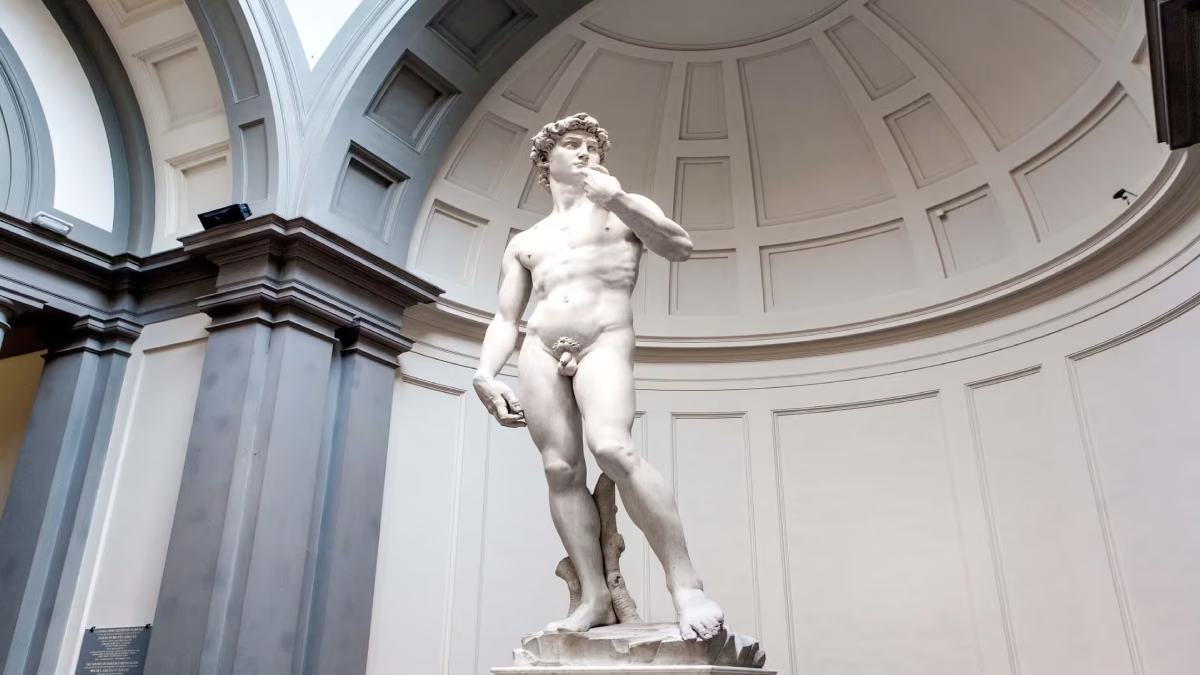
Michelangelo’s David is a 5.17-metre marble statue of the biblical hero David, carved between 1501 and 1504 from a single block of Carrara marble. It stands in the Tribune of the Accademia Gallery in Florence, in a purpose-built domed hall it has occupied since 1873. It is the most famous sculpture in the world, and one of the very few artworks that exceeds what photographs of it prepare you for. Entry is included in the standard Accademia Gallery ticket.
No photograph has ever fully done justice to Michelangelo’s David. This is not a matter of photographic quality. It is a matter of scale, of presence, and of what it means to stand in front of five tonnes of marble carved by a single 26-year-old man into the most perfectly rendered human figure in the history of art. The photographs show what it looks like. Standing in the Tribune shows you what it is.
The Marble Block: A Story of Abandonment
The story of David begins not with Michelangelo but with a block of marble that almost nobody wanted.
In 1463, the Opera del Duomo — the organisation responsible for Florence Cathedral — acquired an enormous block of white Carrara marble measuring approximately 5.5 metres in height. The marble was assigned to the sculptor Agostino di Duccio for a planned series of large prophets for the cathedral’s external buttresses. Agostino began roughing out a figure but abandoned the project after barely starting — some sources suggest he found the marble too challenging; others that the commission simply lost momentum. The block sat untouched.
In 1475, Antonio Rossellino briefly took up the commission and made further cuts into the marble, further complicating what any future sculptor would have to work with. He too abandoned it. The block lay in the cathedral workshop for the next 25 years, increasingly damaged and apparently unusable — too narrow in places for a full figure, worked in ways that constrained what could be carved from it.
When the Opera del Duomo reopened the competition in 1501, they considered Leonardo da Vinci, Andrea Sansovino, and a young sculptor named Michelangelo Buonarroti, already famous for the Pietà he had completed for St. Peter’s Basilica in Rome. Michelangelo was 26. On 16 August 1501, he was officially commissioned. On 13 September 1501, he began.
The constraint of the pre-damaged marble block shaped everything. Because the block had already been cut in certain ways, the final figure could not project far beyond its footprint. This is why David’s arms hang relatively close to his body. It is also, paradoxically, why the finished statue feels so complete — the marble’s limits forced a concentrated, self-contained figure that might not have emerged from unconstrained material.
The Commission: From Cathedral to Civic Symbol
David was commissioned as a religious sculpture, one of a planned series of Old Testament figures for the exterior buttresses of the Florence Cathedral — specifically the spurs around the dome. Had this plan been followed, David would have stood approximately 80 metres above street level, where the scale would have been necessary for visibility and the details invisible to anyone below.
By the time the statue was completed in 1504, opinion had shifted about where it should go. The finished work was clearly too important, too extraordinary, to be placed where nobody could see it properly. A committee of Florence’s leading artists — including Leonardo da Vinci, Sandro Botticelli, Filippino Lippi, and Giuliano da Sangallo — met to debate the statue’s placement. The committee debated at length; Leonardo apparently suggested a sheltered loggia. The final decision placed it in the most prominent political location in Florence: the entrance to Palazzo della Signoria in Piazza della Signoria, the seat of the city’s civic government.
The placement transformed the meaning. What had been a religious commission became a civic statement. David — the small shepherd who defeated the armoured giant through intelligence, courage, and faith rather than brute force — became Florence’s self-image. The city that had expelled the Medici in 1494 and re-established its Republican government saw itself in David: the underdog who had faced down the powerful and prevailed. The nakedness of the figure, bold for a civic sculpture, reinforced the claim: here was humanity at its most essential, unarmoured, relying on mind and will.
David stood in the piazza for over three and a half centuries — through Florentine political upheavals, the return of the Medici, the unification of Italy. In 1873, concern about weathering and the risk of further damage prompted the decision to move the original indoors. The Tribune — the domed hall at the end of the Accademia’s main corridor — was designed specifically for it by the architect Emilio de Fabris. A marble copy was installed in the piazza in 1910.
What You Are Looking At: The Statue Itself
The subject and the moment Every previous depiction of David in Florentine art — Donatello’s bronze, Verrocchio’s bronze, Ghiberti’s relief — shows David after the battle, triumphant, with Goliath’s severed head at his feet or in his hand. Michelangelo made a radical departure: he showed David before the battle, in the moment of concentrated decision.
David stands with his weight on his right leg, his left leg slightly forward in the contrapposto pose — the ancient Greek device for depicting a body in dynamic equilibrium, weight on one side, the opposing shoulder and hip tilting in response, the torso taking a slight S-curve. The pose conveys readiness without aggression. The sling is visible draped over his left shoulder and in his right hand — so unobtrusive that many visitors do not notice it initially. The stone is in his right hand. He is looking to his left — toward Goliath’s approach.
The face and the gaze The expression on David’s face is the most psychologically sophisticated element of the statue. This is not a victorious face, not a fearful one, not a blank ideal. It is a face of intense concentration — the furrowed brow, the slight tension around the jaw, the fixed gaze directed somewhere beyond the viewer. Some scholars describe it as terribilità: the fearful quality that Michelangelo’s contemporaries attributed to his art, a power that unsettles rather than merely impresses.
The proportions: deliberate distortion The head and hands of David are measurably larger than they would be in anatomically correct proportion to the body. The head is approximately one-seventh of the total height rather than the classical one-eighth. The hands — particularly the enormous right hand holding the stone — are significantly oversized.
This was not an error. It was a solution to a design problem that was later superseded. The statue was originally intended for a rooftop position approximately 80 metres above ground, where viewers looking up from below would need the head and hands to be enlarged to read correctly at distance. When the placement changed to eye level in a public square, Michelangelo kept the proportions as designed rather than reworking the marble. The result is a statue that rewards multiple viewpoints: the proportions read correctly from below and at a distance, while the oversized hand becomes a focal point of sculptural intensity when viewed up close.
The anatomy Michelangelo had studied anatomy through the illegal dissection of corpses obtained from the Hospital of Santo Spirito in Florence from his early teens. The David is the fullest expression of that study in his early career. Every detail of the musculature is precise — the iliacus and iliopsoas muscles visible at the groin, the gastrocnemius and tibialis muscles defined in the legs, the deltoid and trapezius across the shoulders. The veins on the dorsum of the right hand are anatomically specific: the basilic vein on the ulnar side of the venous arch, visible as it would be in a hand gripped in tension.
The blood circulation is even rendered: the raised left hand is held at shoulder height, where blood drains by gravity, making the veins there less prominent — exactly as they would be on a living hand in the same position. The lowered right hand, bearing the weight of the stone, shows the more prominent veins of a hand under load. This level of observation is not decorative; it is the result of systematic anatomical study applied to the creation of an ideal rather than a realistic figure.
The Tribune: The Room Built for David
The Tribune — the apsidal domed hall at the end of the Accademia’s main gallery — was designed by Emilio de Fabris specifically to receive David when it was moved from the piazza in 1873. The architecture serves the sculpture: the dome admits natural light through a large skylight, illuminating the marble from above in a way that shifts through the day as the light angle changes. The benches along the walls invite visitors to sit and contemplate rather than simply photograph and move on.
The skylight is particularly effective in the morning. Arriving at the first entry slot (8:15 am) puts you in the Tribune before the crowds fill the room and when the morning light is at its most direct on the marble’s surface.
The Copies: Original vs Replica
There are three versions of David in Florence. The original — the only one carved by Michelangelo — is in the Accademia Gallery. A marble copy stands in its original location in Piazza della Signoria; this was made in the late 19th and early 20th centuries and installed in 1910. A bronze cast stands at Piazzale Michelangelo above the city. Neither copy is a forgery or a deception — both are clearly identified as copies, and the copy in Piazza della Signoria occupies the historically significant original site. But only the Accademia holds the work Michelangelo made.
Conservation History
In 1991, a disturbed visitor attacked David with a hammer concealed in a coat, damaging the toes of the left foot. The damaged pieces were recovered and reattached. The incident prompted significant upgrades to the gallery’s security.
In 2003 and 2004, a major conservation assessment was conducted ahead of the statue’s 500th anniversary. Conservators documented a minor crack in the left ankle and concerns about small fractures in the base, which had been a structural vulnerability since the marble block’s pre-Michelangelo damage. Ongoing monitoring of these structural elements is part of the museum’s conservation programme.
What to Look For When You Visit
The approach through the Prisoners corridor. The design of the Accademia deliberately builds toward David — you walk through the Prisoners first, the four unfinished figures that prefigure David’s perfection. By the time you enter the Tribune, the contrast between the emerging forms of the Prisoners and the fully realised David is part of the visual argument of the space.
Walk around the full circumference. David was designed to be seen in the round — he is not a relief or a frontal figure. The contrapposto reads differently from every angle. The relationship between the tense right hand and the relaxed left hand is only apparent when you move. From directly behind, the musculature of the back and the disposition of the weight through the spine tell a different story from the frontal view.
Find the stone in the right hand. Many visitors focus on the face and the overall scale without noticing the stone clutched in David’s right hand — the weapon that will kill Goliath. It is small, almost understated, a deliberate choice by Michelangelo to emphasise that David’s victory belongs to intelligence, not force.
Look at the hands separately. Compare the raised left hand (less prominent veins, blood drained by gravity) with the right hand gripping the stone (more prominent veins, load-bearing). The anatomical observation is extraordinary.
Sit down. The benches along the Tribune walls exist for a reason. Photographs are taken standing; the experience of the statue changes when you sit and look at it for several minutes from a fixed position. Morning light through the skylight makes this particularly worthwhile in the first hour after opening.
Frequently Asked Questions
Is the David in Piazza della Signoria the original?
No. The original is in the Accademia Gallery, where it has been since 1873. The figure in the piazza is a marble copy installed in 1910.
How tall is Michelangelo’s David?
5.17 metres (17 feet). Including the base, the total height is approximately 5.5 metres. The statue weighs approximately 5.66 tonnes.
How long did it take Michelangelo to carve David?
Approximately two years and eight months, working from September 1501 to completion in early 1504. The statue was unveiled publicly on 8 September 1504.
Why does David have big hands?
The enlarged head and hands were designed for the statue’s originally intended rooftop position on the cathedral, where viewers looking up from below would need exaggerated proportions to read correctly. When the placement changed to ground level, Michelangelo kept the proportions rather than reworking the marble.
Who made the copies of David in Florence?
The marble copy in Piazza della Signoria was made in the late 19th and early 20th centuries by Italian craftsmen and installed in 1910. The bronze copy at Piazzale Michelangelo was cast in the 19th century.
How do I get to see David?
Book a timed-entry ticket to the Accademia Gallery in advance. See our entry ticket guide for all options and prices. —
