
The Accademia Gallery: History & Architecture
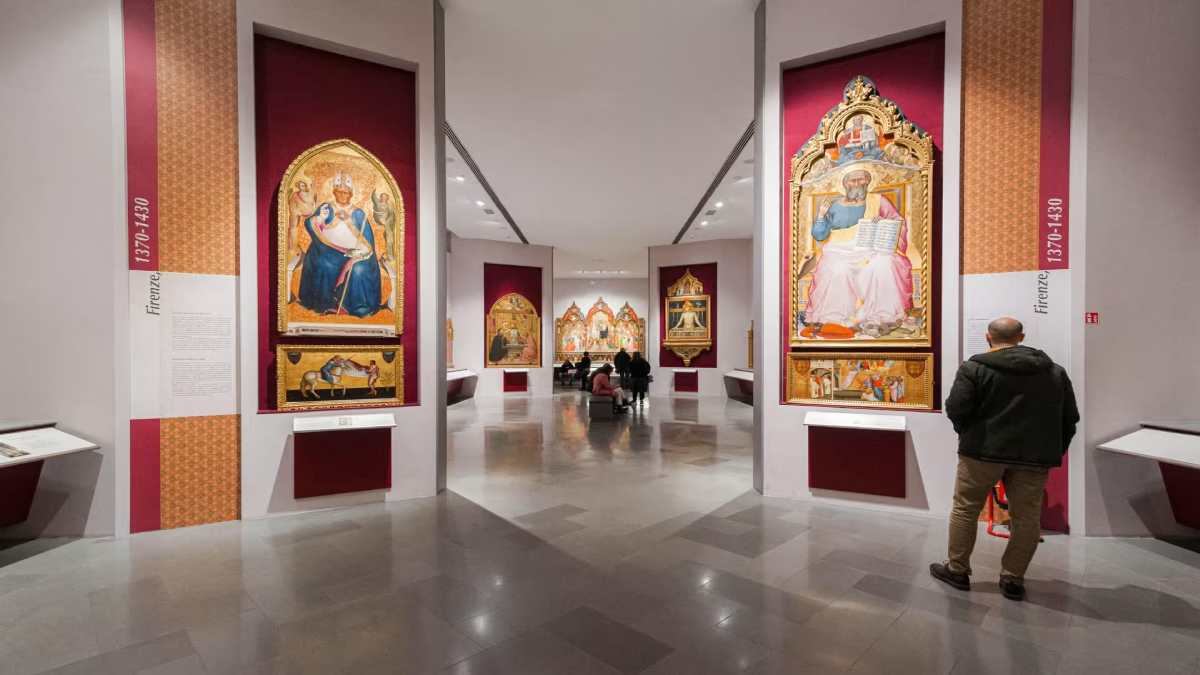
The Accademia Gallery occupies buildings that were originally a 14th-century hospital (the Hospital of San Matteo) and a medieval convent (the Convent of San Niccolò di Cafaggio). It was founded as a teaching museum in 1784 by Grand Duke Pietro Leopoldo of Lorraine and became the museum visitors know today in 1882, when the Tribune — the domed hall purpose-built for Michelangelo’s David — was completed by architect Emilio de Fabris. The institution traces its roots to Cosimo I de’ Medici’s founding of the Accademia delle Arti del Disegno in 1563.
The Accademia Gallery is not a palace or a purpose-built museum. It is a medieval hospital and a convent that were converted, expanded, and repurposed over 500 years into one of the world’s most visited art institutions. Understanding this architectural history — the layers of use and meaning deposited in the building’s walls — gives the experience of visiting it a different texture from most major museums.
The Medieval Buildings: Hospital and Convent
The site the Accademia occupies has been continuously in institutional use since the 14th century. The principal building that became the museum’s core was the Hospital of San Matteo, established in the Cafaggio area of Florence — a district north of the Cathedral that was, in the medieval period, on the edge of the city’s urban core. The hospital was formally in service by approximately 1410 and occupied a substantial complex of buildings at the corner of what is now Piazza San Marco.
Adjacent to the hospital was the Convent of the Nuns of San Niccolò di Cafaggio, a medieval monastery whose buildings ran along the beginning of Via del Cocomero (now Via Ricasoli) and Via del Ciliegio (now Via Alfani). These two complexes — the hospital and the convent — together form the physical substance of what became the Accademia Gallery.
The hospital’s function during the medieval and early modern period was primarily practical: the care of the sick in a period when such institutions were administered by religious orders. The building’s character — long wards, internal courtyards, ancillary service spaces — was determined by that function. When the buildings were later repurposed for art education, those institutional bones shaped what could be done with the space.
The Founding of the Accademia delle Arti del Disegno (1563)
The institutional predecessor of the Accademia Gallery was not a museum but a school. In 1563, Cosimo I de’ Medici — the first Grand Duke of Tuscany and the most powerful patron of the arts in 16th-century Florence — founded the Accademia delle Arti del Disegno (Academy of the Arts of Drawing) in Florence. It was among the first formal academies of fine arts in Europe, and its founding reflects the Medici conviction that art was not merely a craft to be taught through guild apprenticeship but a liberal intellectual discipline worthy of systematic institutional organisation.
The Academy’s founding members included Michelangelo himself (then in his late eighties, living in Rome), Giorgio Vasari, and Bronzino. Michelangelo’s nominal connection to the institution he never actually visited gave it a prestige that outlasted his death in 1564. The Academy was established not in the Cafaggio buildings but at Santissima Annunziata, and it remained the primary artistic institution in Florence for the next two centuries.
Grand Duke Pietro Leopoldo and the 1784 Transformation
The Accademia Gallery as a physical institution dates from 1784, when Grand Duke Pietro Leopoldo of Lorraine — an Enlightenment ruler who introduced significant administrative and educational reforms across the Grand Duchy of Tuscany — reorganised the Academy of Drawing Arts into a modern Academy of Fine Arts and relocated it to the Cafaggio buildings.
On 21 August 1784, Pietro Leopoldo issued a decree (“motuproprio”) consolidating all existing drawing schools in Florence under the new institution. The Hospital of San Matteo was adapted for the Academy’s use by the architect Gaspare Mattia Paoletti, a professor of architecture at the institution, assisted by Bernardo Fallani and Giuseppe Paoletti. The former men’s ward of the hospital became a gallery for plaster casts and sculptural models; the women’s ward became a painting gallery.
In 1787, Pietro Leopoldo acquired the entire adjacent Convent of the Nuns of San Niccolò for 5,315 lire, expanding the institution significantly. The complex was restructured by architect Bernardo Fallani, with subsequent renovations by Francesco Mazzei in the 1850s to accommodate the Luigi Cherubini Conservatory (established 1857) in the former convent section.
The gallery Pietro Leopoldo created was explicitly educational in purpose — a collection of plaster casts, models, and paintings assembled to give Academy students access to exemplary works for study and copying. Early displays included Giambologna’s plaster model for the Rape of the Sabines and various paintings transferred from suppressed religious institutions. It was, from the beginning, a teaching museum rather than a prestige collection.
The Napoleonic Suppressions (1786–1810)
Two waves of religious suppression significantly expanded the Accademia’s collection. Pietro Leopoldo himself ordered the suppression of various Florentine churches and convents in 1786, and the resulting dispersal of their contents brought a substantial body of altarpieces and devotional panels to the gallery. Napoleon Bonaparte’s suppression of religious institutions across Italy in 1810 brought another wave of material — particularly the gold-ground panel paintings from Florentine churches and monasteries that now form the Byzantine and Gothic collection.
This explains the character of the Accademia’s painting collection: it is not a curated anthology of the greatest Florentine painters but a genuine survival of the religious artistic production of specific Florentine institutions, transferred to a secular museum for preservation when those institutions ceased to exist. The altarpieces in the Gothic Gallery were in situ in their original churches for centuries before arriving here — objects of devotion before they became objects of study.
The Arrival of David: 1873 and the Tribune
The event that transformed the Accademia from a significant but specialised art school collection into an internationally famous museum was the arrival of Michelangelo’s David.
On 31 July 1873, the marble David was moved from its outdoor position in Piazza della Signoria — where it had stood since 1504, through every Florentine political upheaval, through rain and frost and the growing air pollution of the 19th century — to the Accademia Gallery for conservation. The immediate impetus was the deterioration of the marble’s surface from weathering and atmospheric exposure, combined with the damage of a 1527 riot during which the statue’s left arm had been broken. Long-term preservation required an indoor environment.
The move presented an architectural problem: the existing gallery had no space large enough to receive a 5.17-metre marble statue with the dignity such a work required. The solution was to commission a purpose-built room.
The Tribune was designed by Emilio de Fabris (1808–1883), the same architect who had completed the long-unfinished marble façade of Florence Cathedral in 1887. De Fabris designed an apsidal hall with a domed roof pierced by a large circular skylight — the distinctive feature that floods the Tribune with natural light from above, illuminating the marble’s surface in a way that changes through the day. The Tribune was not completed immediately after David’s arrival; the statue spent nine years in a wooden protective box while construction proceeded. The Tribune was inaugurated in 1882, and the Accademia in its present form — with the Galleria dei Prigioni as the approach corridor and the Tribune as the destination — dates from that year.
The 20th Century: Additions and Consolidation
Following the inauguration of the Tribune, subsequent decades brought further additions to the collection and to the building’s public function.
The Prisoners — the four unfinished Michelangelo figures that had decorated the Boboli Gardens since the 1590s — were transferred to the Accademia in 1908 and 1909, installed in the Galleria dei Prigioni as an intentional curatorial sequence leading toward David. St. Matthew was acquired in 1906.
The Gipsoteca Bartolini — the plaster cast gallery of Lorenzo Bartolini’s 19th-century workshop — was added to the museum in the 1980s, housed in the Salone dell’Ottocento (the former women’s ward of the original hospital, used in the 19th century for lecture rooms and studio spaces).
The Byzantine-style rooms, dedicated to the gold-ground panel paintings, were opened around 1950, in the same period that the Hall of the Colossus was reorganised in its current form.
The Museum of Musical Instruments — the Cherubini Conservatory’s collection of Medici and Lorraine court instruments — was formally established as part of the Accademia in 1996, when the instruments were deposited on long-term loan, and opened to the public in 2001 in three dedicated rooms of the former convent section.
In 2014, the Accademia was granted special institutional autonomy as a self-directing museum — part of a broader Italian government reform that gave major state museums independent administrative status.
In March 2026, the most recent institutional change came into effect: the Accademia joined the Bargello National Museum and four other Florentine institutions in a new unified body, the Galleria dell’Accademia di Firenze e Musei del Bargello, with combined ticketing across all six museums.
World War II: The Brick Hive
One of the lesser-known episodes in the Accademia’s history occurred in January 1943, when a protective brick structure was built around Michelangelo’s David inside the Tribune to shield it from potential bomb damage. Florence was under German occupation and Allied bombing of the city was a real threat. The brick structure — described in contemporary accounts as a kind of hive around the statue — remained in place until after the Liberation of Florence in August 1944. David emerged from its wartime shelter intact.
The Building Today: What You Are Walking Through
The building visitors enter today at Via Ricasoli 58/60 layers these periods of use in ways that are sometimes visible, sometimes obscured by later renovation.
The entrance foyer and main gallery corridor occupy what was the men’s ward section of the Hospital of San Matteo — a long hall designed for rows of hospital beds. The Gipsoteca Bartolini, the large domed room off the Tribune, was the women’s ward, later adapted as a lecture room and studio. The Tribune itself is entirely a 19th-century addition, an exedra built onto the back of the medieval hospital complex by Emilio de Fabris.
The former convent section, to the right of the main entrance, now houses the Cherubini Conservatory and the Museum of Musical Instruments. The street-facing facade of the building — modest, institutional, undramatic — reflects its origin as a hospital rather than a palace or purpose-built museum. This plainness is part of the experience: nothing on the exterior prepares you for what is inside.
The institutional connection with the Academy of Fine Arts (Accademia di Belle Arti), which still occupies adjacent buildings and shares the street address on Via Ricasoli, is historical rather than administrative — the two institutions are entirely separate, despite the shared name and location.
Key Dates
| Year | Event |
|---|---|
| c. 1410 | Hospital of San Matteo in service |
| 1563 | Cosimo I de' Medici founds the Accademia delle Arti del Disegno |
| 1784 | Grand Duke Pietro Leopoldo establishes the Academy of Fine Arts and gallery in the Cafaggio buildings |
| 1786 | First Napoleonic-era church suppressions bring paintings to the gallery |
| 1787 | Pietro Leopoldo acquires the adjacent convent of San Niccolò |
| 1810 | Napoleon's suppressions bring the gold-ground altarpieces |
| 1873 | Michelangelo's David moved from Piazza della Signoria |
| 1882 | Tribune completed; Accademia in its present form inaugurated |
| 1906–1909 | St. Matthew acquired; Prisoners transferred from Boboli Gardens |
| 1943–1944 | David protected by a brick structure during WWII |
| 1984 | 1980s: Gipsoteca Bartolini added to public galleries |
| 1991 | David attacked by a visitor with a hammer; security enhanced |
| 1996–2001 | Musical Instruments collection deposited and opened to public |
| 2014 | Accademia granted special institutional autonomy |
| 2026 | New unified institution with Bargello National Museum and four others |
Frequently Asked Questions
When was the Accademia Gallery founded?
The gallery in its modern form dates from 1784, when Grand Duke Pietro Leopoldo established the Academy of Fine Arts in the Cafaggio buildings. The institution’s roots go back to Cosimo I de’ Medici’s founding of the Accademia delle Arti del Disegno in 1563.
Who designed the Tribune that houses David?
The architect Emilio de Fabris (1808–1883), who also designed the marble façade of Florence Cathedral. The Tribune was built between 1873 and 1882 specifically to receive Michelangelo’s David.
Why is the building so plain from the outside?
Because it was originally a hospital, not a palace or purpose-built museum. The 14th-century Hospital of San Matteo was a functional institutional building; its plainness was practical, not aesthetic.
Is the Academy of Fine Arts the same as the Accademia Gallery?
No — despite sharing the street address and a historical connection, the Galleria dell’Accademia and the Accademia di Belle Arti are entirely separate institutions today. The art school still operates in adjacent buildings; the museum is independently administered. —
