
The Prisoners (Slaves) by Michelangelo: An In-Depth Look
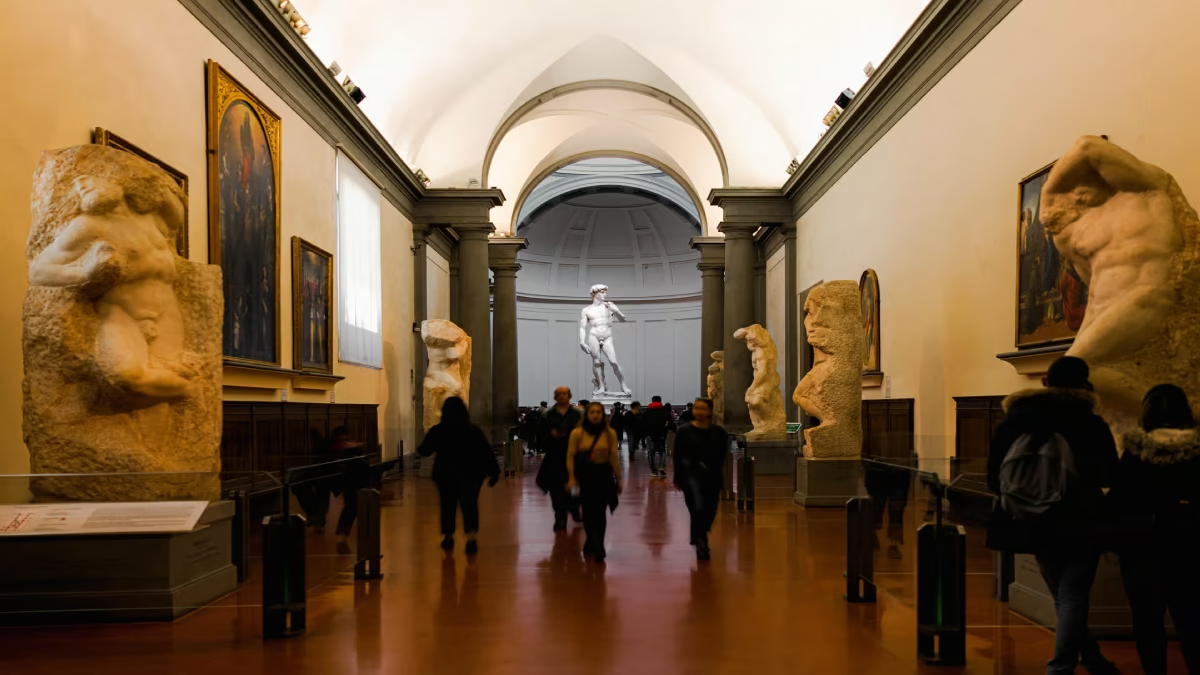
The four Prisoners (also called Slaves) are a series of large unfinished marble sculptures by Michelangelo, displayed in the long corridor leading to David at the Accademia Gallery. Carved between approximately 1519 and 1534 for the planned tomb of Pope Julius II — a project that was progressively reduced over 40 years — they were donated to the Medici after Michelangelo’s death, placed in the Boboli Gardens, and transferred to the Accademia in 1908. Their unfinished state is among the most debated topics in Renaissance art scholarship: was it accidental, or the most deliberate thing Michelangelo ever did?
Most visitors walk down the Galleria dei Prigioni with their eyes fixed on David at the far end. This is understandable — David is the destination, and the corridor is designed to build toward it. But passing the Prisoners without stopping is one of the most common acts of inadvertent self-deprivation in all of Florence tourism.
The four figures emerging from raw marble blocks in this corridor are not unimportant preliminary sketches. They are some of the most philosophically complex and technically remarkable sculptures Michelangelo ever made, and they tell a story — about an impossible commission, a troubled relationship between an artist and a pope, and the deepest question in Michelangelo’s art — that makes David more comprehensible rather than less.
The Commission: The Tragedy of the Tomb
The origin of the Prisoners is inseparable from one of the most protracted and painful episodes in Michelangelo’s career: the tomb of Pope Julius II della Rovere.
In 1505, Michelangelo was summoned to Rome by Julius II, the warrior pope who had recently secured his political position and wanted a monument to match his sense of himself. The commission was staggering in its ambition: a freestanding three-storey mausoleum to be placed in St. Peter’s Basilica, approximately 10 metres wide and 7 metres deep, adorned with over 40 marble statues. It was, as Michelangelo’s first biographer Ascanio Condivi later wrote, the grandest project given to any sculptor since classical antiquity.
Michelangelo spent eight months quarrying marble in Carrara for the project and shipped enormous quantities of stone to Rome. Then Julius II changed his mind. The Pope redirected funds to rebuilding St. Peter’s Basilica itself and, famously, ordered Michelangelo to paint the Sistine Chapel ceiling instead. Michelangelo, who considered himself primarily a sculptor, was furious and humiliated. He fled Rome. Papal messengers pursued him as far as Poggibonsi. He later wrote that had he stayed, his own burial would have been completed before the pope’s.
Julius died in 1513 with the tomb incomplete. The commission passed to his heirs, who negotiated with Michelangelo through a succession of contracts, each one reducing the project’s scale, over the next 32 years. A first revision (1513) scaled back to 20 figures. A second (1516) to 18 figures. A third (1526) to a wall tomb with perhaps 6 figures. The final version, installed in 1545 in the Roman church of San Pietro in Vincoli, was a fraction of the original vision — essentially a wall facade with the monumental Moses as its centrepiece and five other statues, of which only Moses and two parts of other figures are entirely by Michelangelo’s hand.
Michelangelo himself called the project “the tragedy of the tomb.” He spent the rest of his life feeling he had failed Julius II, even as the successive contracts that reduced the scope were driven as much by the heirs’ financial constraints and political shifts as by any failing on his part.
The four Prisoners in the Accademia were carved during the later phases of this extended project — most likely between approximately 1519 and 1534 — for versions of the tomb that were themselves superseded before the figures were completed. When Michelangelo left Florence permanently for Rome in 1534, the figures remained in his studio on Via Mozza.
The Figures in Detail
The four Prisoners are known by names given to them later — they appear to have had no titles in Michelangelo’s lifetime — based on their postures and the degree to which each figure has emerged from the marble.
The Awakening Slave (Lo Schiavo che si ridesta) The least finished of the four, and in many ways the most dramatic because of it. A large male figure lies partly on his back, one arm raised above the head, the face barely differentiated from the surrounding marble. The figure appears to be surfacing — swimming upward through stone, or waking from it. The musculature of the torso and thigh is roughed out but unresolved; the tools’ marks are clearly visible, showing the progression from mass to form that the finished figures would have completed. The Awakening Slave is Michelangelo’s method made visible at its most essential.
The Young Slave (Lo Schiavo giovane) A more advanced figure — the torso and arms more fully worked, the face beginning to emerge with recognisable human features. The figure twists in a complex contrapposto, one arm raised and bent behind the head. The sense of strain is palpable — this is a body under effort, turning against its own weight or the weight of the marble surrounding it. The smooth sections of resolved marble are in direct and startling contrast with the rough-hewn passages still in the initial stages of carving.
The Bearded Slave (Lo Schiavo barbuto) The most fully resolved of the four — the figure has emerged furthest from the stone, with a strongly bearded, heavily muscled male figure visible in considerable detail. One arm is raised; the other falls toward the side. The figure has a quality of exhaustion or resignation that differentiates it from the Awakening Slave’s more dynamic posture. Despite being the most finished of the four, it is still clearly incomplete: the lower legs merge with the unworked marble base.
The Atlas Slave (Lo Schiavo atlante) Named for the mythological titan condemned to bear the weight of the sky, this figure appears to carry a massive weight — a block of unworked marble sits above the figure’s bowed head, pressing down on a body that strains to support it. The metaphor is explicit: the marble that surrounds the figure is not simply raw material waiting to be removed; it is the burden the figure endures. The Atlas Slave is often considered the most philosophically suggestive of the four because it makes the marble itself a participant in the figure’s meaning.
St. Matthew (also in the Galleria dei Prigioni) Displayed alongside the Prisoners, St. Matthew belongs to a different commission — begun in 1503 for Florence Cathedral’s façade as the first of a planned series of twelve Apostles — and is generally dated slightly earlier. When Michelangelo left Florence for Rome after the Sistine Chapel commission, Matthew was left incomplete. The figure twists in a deeply complex serpentine movement, the torso fully worked in front while the back remains rough stone. It is often cited as the most dramatic example of Michelangelo’s technique of carving from the front face of the block, liberating the figure from one surface while leaving the reverse untouched.
The Non-Finito Question: Accident or Intent?
The most contested question about the Prisoners is also the most interesting: were they left unfinished because circumstances intervened, or did Michelangelo deliberately leave them this way?
The circumstantial answer is clear — the commission was repeatedly restructured, the figures became surplus to subsequent versions of the tomb, and Michelangelo abandoned them when he left Florence. They are unfinished because the project that required them was abandoned.
But a body of scholarship argues for something more. Michelangelo was deeply influenced by the Neoplatonic philosophy of Marsilio Ficino and the circle of Lorenzo de’ Medici, where he trained as a young artist. At the heart of Florentine Neoplatonism was the idea that material reality is a prison from which the soul strives toward ideal form — that all existence is a struggle of spirit against matter. For Michelangelo, who described his sculptural process as liberating the figure already imprisoned within the marble, this was not abstract philosophy but a description of what he actually did every day with chisel and hammer.
Under this reading, the Prisoners are not merely incomplete works. They are the most complete expression of his deepest theme: the soul’s struggle to free itself from the material world. David — smooth, resolved, standing free of the stone — represents the soul fully liberated. The Prisoners represent the struggle that precedes that liberation. The unfinished state is not a deficiency; it is the subject.
Art historians disagree about how much of this reading is retrospective interpretation and how much was intentional. The distinguished American art historian Charles de Tolnay argued strongly for intentional non-finito in the Prisoners. Others, including the Italian scholar Rocky Ruggiero, have argued persuasively that the figures were not left unfinished by design and that the philosophical reading, however powerful, was not Michelangelo’s primary intention.
The dispute may be unresolvable. What is not in dispute is that standing in front of these figures, the unfinished quality produces a more immediate and affecting response than most finished sculpture in any museum.
Provenance: From Studio to Boboli Gardens to the Accademia
After Michelangelo’s death in 1564, the four Prisoners were donated by his nephew Leonardo Buonarroti to the Medici Grand Duke Cosimo I. The Grand Duke, who was assembling a collection of Michelangelo’s works in Florence, placed the figures in the Cave of Buontalenti — an artificial grotto in the Boboli Gardens behind Palazzo Pitti — where they remained for over three centuries as decorative architectural elements at the four corners of the grotto’s first room.
In 1908, the originals were removed from the Boboli Gardens (replaced by casts) and transferred to the Accademia Gallery, where the curator had been building a focused Michelangelo collection. They were installed in the Galleria dei Prigioni as a conscious curatorial decision — the corridor that leads to David, positioning the unfinished figures as a prologue to the finished one.
The two Prisoners carved earlier — the Dying Slave and the Rebellious Slave, both nearly complete — were given by Michelangelo himself to Roberto Strozzi in 1544, eventually passing to France and entering the French royal collection. They are now in the Louvre in Paris. Visitors to both Florence and Paris can, in effect, see the complete set of Prisoners from the Julius II tomb: the two finished ones in Paris, the four unfinished ones in Florence.
What to Look For in the Gallery
Approach from the entrance and walk the full length. The positioning of the Prisoners on both sides of the corridor is designed to frame and build toward David. As you walk, the figures on your left and right create a kind of sculptural conversation. Looking back down the corridor from the Tribune is a different experience from the approach — from David’s position, the Prisoners appear as attendants, heralding rather than preceding.
Look at the tool marks. The Prisoners preserve what finished sculpture erases — the evidence of process. The point chisel creates rough preliminary masses; the toothed claw chisel (gradina) refines the form; the flat chisel and abrasives bring the surface to smoothness. On the Awakening Slave, all stages are visible simultaneously. On the Bearded Slave, the most advanced figure, you can trace the transition from rough to refined across a single body.
Notice the degree of completion varies within each figure. The front face is always more finished than the back. In St. Matthew, the front of the torso has been worked to a level of anatomical precision while the back remains the raw surface of the marble block. This reveals Michelangelo’s technique: he carved from the front surface inward, liberating the figure progressively rather than working the full block uniformly.
The Atlas and the marble above his head. The Atlas Slave is the most explicit commentary on the act of carving in Michelangelo’s entire output. The block of unworked marble resting on the figure’s bent head is the same material that surrounds the rest of the figure — but in this case, Michelangelo has positioned it as burden rather than matrix. It is the most direct statement in the Renaissance of what it means to be imprisoned in matter.
Frequently Asked Questions
Are the Prisoners by Michelangelo actually finished or unfinished?
Unfinished in the sense that work was interrupted before their surfaces were brought to completion. The debate is whether the unfinished state was intentional — an expression of Neoplatonic philosophy about the soul imprisoned in matter — or circumstantial, a result of the tomb commission’s repeated restructuring. Both readings have scholarly support.
Why are only four Prisoners in Florence when six are known?
The original design envisioned potentially 16 or more prisoner figures; subsequent revisions reduced this to 8, then 4, then eliminated them entirely. Of the six figures actually carved to any degree, the two most nearly finished — the Dying Slave and the Rebellious Slave — were given by Michelangelo to Roberto Strozzi in 1544 and eventually acquired by the French royal collection. They are now in the Louvre in Paris.
Where are the Prisoners displayed in the Accademia?
In the Galleria dei Prigioni — the long corridor connecting the Hall of the Colossus to the Tribune where David stands. Two figures line each side of the corridor. St. Matthew is displayed in the same corridor.
Why are they called both Prisoners and Slaves?
Both names are in common use and both refer to the same figures. “Prisoners” (Prigioni) is the Italian term most commonly used in the Accademia and in Italian scholarship. “Slaves” is more common in English-language art history. Neither term appears to have been used by Michelangelo himself. —
