
The Museum of Musical Instruments: Florence's Hidden Gem
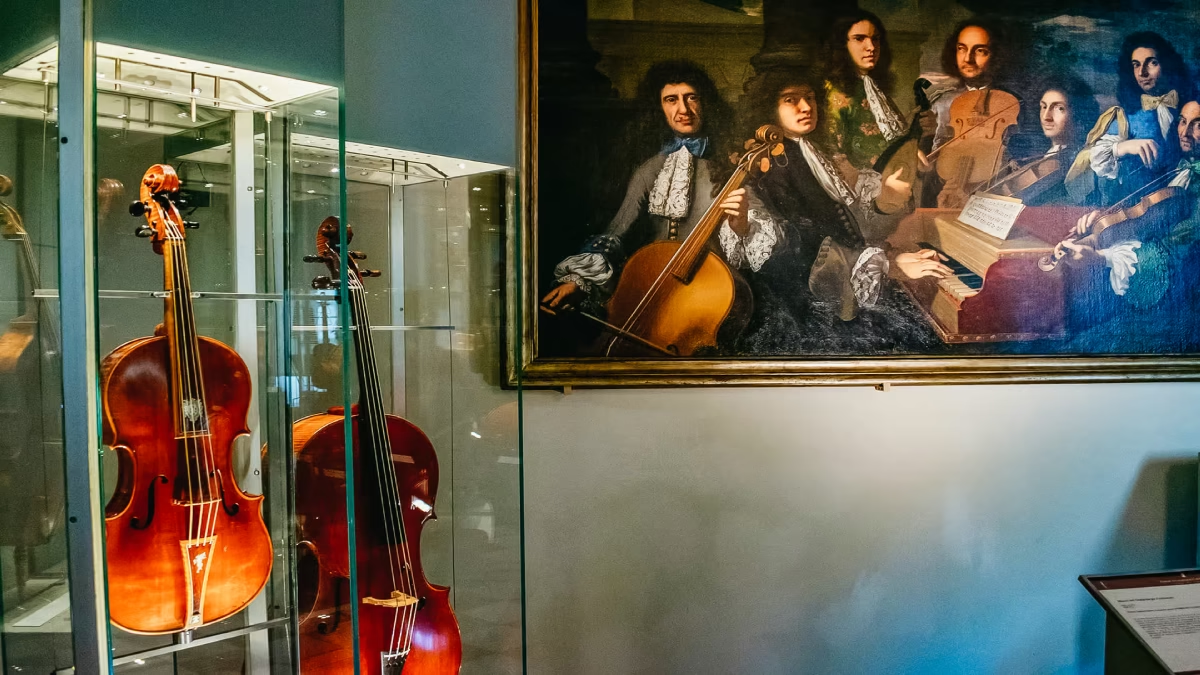
The Museum of Musical Instruments on the upper floor of the Accademia Gallery houses approximately 50 historic instruments from the private collections of the Medici and Lorraine Grand Dukes of Tuscany, collected between the mid-17th and early 19th centuries. Highlights include instruments by Bartolomeo Cristofori — inventor of the piano — Antonio Stradivari, and Niccolò Amati. The earliest surviving upright piano (1739, by Domenico Del Mela) and Cristofori’s 1690 oval spinet are among the most historically significant objects in the collection. It is included in the standard Accademia Gallery ticket and is almost always the quietest part of the museum.
Most visitors to the Accademia Gallery walk past the entrance to the musical instruments section entirely. The pull of David is strong, and the signage is subtle. This is a consistent and regrettable pattern — the collection upstairs contains objects of extraordinary rarity, including instruments that changed the course of Western music history, displayed in rooms with fewer than a dozen visitors at any time even on the museum’s busiest days.
History of the Collection
The collection originated with the Medici Grand Dukes of Tuscany, particularly Grand Prince Ferdinando de’ Medici (1663–1713), who was one of the most passionate music patrons in 17th-century Europe. Ferdinando assembled a court of exceptional musicians and instrument makers at his Villa at Pratolino and the Palazzo Pitti in Florence, and commissioned or acquired instruments of the highest quality from the leading luthiers of the period.
On his death in 1713, the instruments passed through successive Medici and then Lorraine Grand Duke collections, eventually transferred to the Luigi Cherubini Conservatory of Florence in the 19th century. Since 1996 they have been on long-term loan to the Accademia Gallery, where they were opened to the public in 2001 in a dedicated section of the museum.
Approximately 50 instruments are on display. A further 300 instruments of primarily Tuscan construction are held in storage and can be viewed by scholars, musicians, and instrument makers by prior appointment. The collection also includes a specialised library open by appointment.
The Instruments: What to See
Bartolomeo Cristofori: Inventor of the Piano
The most historically significant figure represented in the collection is Bartolomeo Cristofori (1655–1732), the Padua-born instrument maker who came to Florence in 1688 at the invitation of Grand Prince Ferdinando and spent the rest of his life in the city’s service.
Cristofori is credited with inventing the piano — or more precisely, with solving the technical problem that had prevented earlier instrument makers from building a keyboard instrument capable of both soft and loud expression. The harpsichord, the dominant keyboard instrument of the period, plucks its strings regardless of how hard the keys are struck, producing a uniformly bright sound with no dynamic range. Cristofori replaced the plucking mechanism with a hammer mechanism — strings struck rather than plucked, with the hammer immediately rebounding so as not to damp the vibration. This allowed the player’s touch to control the volume directly, producing what Cristofori called a “gravicembalo col piano e forte” — a harpsichord with soft and loud. The name contracted over time to fortepiano and eventually piano.
Cristofori documented this invention in a Florentine journal in 1700, and the Accademia collection contains two instruments by his hand:
The 1690 Oval Spinet Cristofori’s earliest surviving work, built for Grand Prince Ferdinando in 1690 — nearly a decade before his documented piano invention. The oval form is exceptionally rare; almost no other example survives. It represents the type of instrument Cristofori was building in the years immediately before his breakthrough.
The Ebony Harpsichord A second Cristofori instrument in the collection, built in rare ebony — an exceptionally difficult wood to work — demonstrates the level of craftsmanship and material investment that Ferdinando’s patronage supported.
The Earliest Surviving Upright Piano: Domenico Del Mela, 1739 Also in the collection is the earliest surviving upright piano, built in 1739 by Domenico Del Mela. This instrument post-dates Cristofori’s invention by approximately 40 years and represents the upright adaptation of his mechanism — a key step in the piano’s development toward the form most people play today.
Note on the Cristofori fortepiano: Multiple sources refer to a “Cristofori fortepiano” or “Cristofori piano” in the Accademia collection. The exact instrument referred to varies by source — some cite the oval spinet, others a separate early fortepiano. Only three instruments definitively attributed to Cristofori’s piano mechanism survive in the world: one in the Metropolitan Museum of Art in New York (1700), one in the Museo Nazionale degli Strumenti Musicali in Rome (1722), and one in the Musikinstrumenten-Museum in Leipzig (1726). Visitors to the Accademia see Cristofori’s earlier oval spinet and harpsichord, which predate the piano invention, alongside the 1739 Del Mela upright piano.
Antonio Stradivari: The Medici Quintet
The Stradivari instruments in the collection are among the most remarkable in the world — not merely because of their maker’s reputation, but because of their provenance and preservation.
In 1690, Grand Prince Ferdinando commissioned Antonio Stradivari of Cremona to build a matched set of instruments — a string quintet — for performance at his court. The quintet comprised two violins, a viola, a tenor viola, and a cello, all built by Stradivari in the same year and delivered as a set. Most of the quintet’s instruments have since been dispersed, but the Accademia holds the tenor viola and the cello from this original 1690 commission.
The 1690 Tenor Viola (Viola tenore) Widely described as the only surviving Stradivari in entirely original condition — never modified, never repaired with later materials, never adapted to meet the changing fashions of performance practice that prompted most other Stradivari instruments to be altered over the centuries. The vast majority of known Stradivari violins and violas have had their necks replaced, their string lengths altered, and their internal bass bars updated to produce the louder sound demanded by larger concert halls in the 19th century. This tenor viola was never played again after the Medici court, and was thus preserved in the condition Stradivari intended. For instrument historians, it is among the most important objects in the world for understanding what Stradivari actually built.
The 1690 Cello The companion cello from the same Medici commission, also in the collection.
The 1716 Stradivari Violin A later Stradivari instrument, from the peak period of his output, displayed alongside the 1690 pieces.
The 1650 Niccolò Amati Cello Niccolò Amati (1596–1684) was the master luthier of Cremona under whom Stradivari himself trained before establishing his own workshop. The 1650 Amati cello in the collection predates the Stradivari instruments by 40 years and represents the tradition from which Stradivari’s work emerged.
Other Notable Instruments
The Psaltery made of marble An unusual instrument described in the official collection as “unique of its kind” — a psaltery (a medieval plucked string instrument) constructed entirely from different types of marble rather than wood. The acoustic properties of marble produce a distinctly different resonance, and the instrument’s material is as much a statement of Medici wealth and luxury as a functional choice.
Wind instruments The collection includes examples of the Giorgi flute, the Briccialdi flute, and a “bimbonifono” — a trombone with a mechanism designed to enable legato and trills in the lower brass register. The wind instruments in the collection are less famous than the Stradivari and Cristofori pieces but contribute to a picture of the full instrumental range available to the Medici court.
The Paintings in the Music Rooms
The instruments are displayed alongside contemporaneous paintings that document the musical culture of the Medici court. Two important cycles are worth noting:
Anton Domenico Gabbiani painted a series of portraits between 1685 and 1690 depicting Grand Prince Ferdinando surrounded by the musicians of his court. The paintings are so faithful in their depiction of instruments and musicians that art historians have been able to identify specific named individuals in the portraits — including Pietro Salvetti and Francesco Veracini, composers and music directors for the Medicis. The instruments depicted in the paintings can be matched to instruments in the collection.
Bartolomeo Bimbi contributed still-life paintings of tables set with musical instruments alongside food and flowers — a genre popular in 17th-century court contexts that combined display of wealth with the pleasures of music and the table.
The Cristofori Room also contains a series of 17th-century still-life paintings depicting musical instruments alongside elaborate table settings, providing context for the instruments’ role in court entertainment.
The Multimedia Stations
Six computer stations in the musical instruments section allow visitors to hear recordings of many of the instruments on display, including comparisons between the sound of the harpsichord and Cristofori’s fortepiano mechanism. A video traces the history of theatrical performance in Florence, rooted in the context of the Camerata de’ Bardi — the intellectual circle that included Vincenzo Galilei (father of Galileo) and contributed to the invention of opera in the late 16th century.
These multimedia elements are among the better museum technology implementations in Florence — genuinely informative rather than merely decorative. Allow 10–15 minutes for the audio and video content if you have the time.
The Alessandro Kraus Room
One room in the musical instruments section is dedicated to Alessandro Kraus (1853–1931), a Florentine musicologist, anthropologist, and collector whose library was donated to the Accademia by his heir Mirella Gatti-Kraus in 2008. The collection includes over 200 volumes on music history and 387 opera librettos, some from the 17th century. The oldest libretto in the collection dates to 1675. This is a specialised area of interest but provides a rare glimpse into 19th-century musicological scholarship.
Practical Information
Location: Upper floor of the Accademia Gallery, accessible by lift or stairs from the ground floor entrance area. The section is to the right of the main building entrance — many visitors miss it by turning immediately into the main gallery.
Access: The upper floor section closes at 6:40 pm, 10 minutes before the museum’s main closing time of 6:50 pm. If you plan to visit the instruments, do not leave it to the final 10 minutes.
Ticket: Included in the standard Accademia Gallery entry ticket — no separate charge.
Crowds: Consistently the quietest section of the museum, on all days and at all times. A realistic visit of 15–20 minutes for the instruments will almost certainly be made in near-solitude.
Photography: Permitted for personal use, no flash.
Why This Section Is Worth Your Time
The Museum of Musical Instruments is not a minor appendage to the Accademia Gallery. It contains the instruments that were present at the invention of the piano, the best-preserved Stradivari viola in the world, and a window into the Medici court’s musical culture that no other collection offers. On the busiest summer day, with hundreds of visitors crowded around David’s base in the Tribune below, the Cristofori room upstairs will have a handful of people in it at most.
If you play an instrument — particularly piano or any stringed instrument — this is an encounter with the origin of your musical tradition. If you do not, the Stradivari tenor viola in original condition is an object of extreme rarity by any standard. Either way, 15–20 minutes spent here add depth to the Accademia visit that most visitors leave behind.
Frequently Asked Questions
Does the Accademia Gallery have Cristofori’s piano?
The Accademia holds two instruments by Bartolomeo Cristofori: his 1690 oval spinet and an ebony harpsichord. These predate his documented piano invention of c.1700. The three surviving definitive Cristofori pianos are in New York (Met), Rome (Museo Nazionale), and Leipzig. The collection also holds the earliest surviving upright piano (1739, by Domenico Del Mela).
What Stradivarius instruments are at the Accademia?
The collection includes a tenor viola (1690) and cello (1690) from the Medici commission — the tenor viola is considered the only surviving Stradivari in entirely original unmodified condition — plus a violin from 1716.
Is the music instruments section included in the entry ticket?
Yes — fully included in the standard Accademia Gallery entry ticket.
When does the music instruments section close?
The upper floor section, including the musical instruments, closes at 6:40 pm — 10 minutes before the main museum closing at 6:50 pm. —
