
Top 10 Masterpieces at the Accademia Gallery
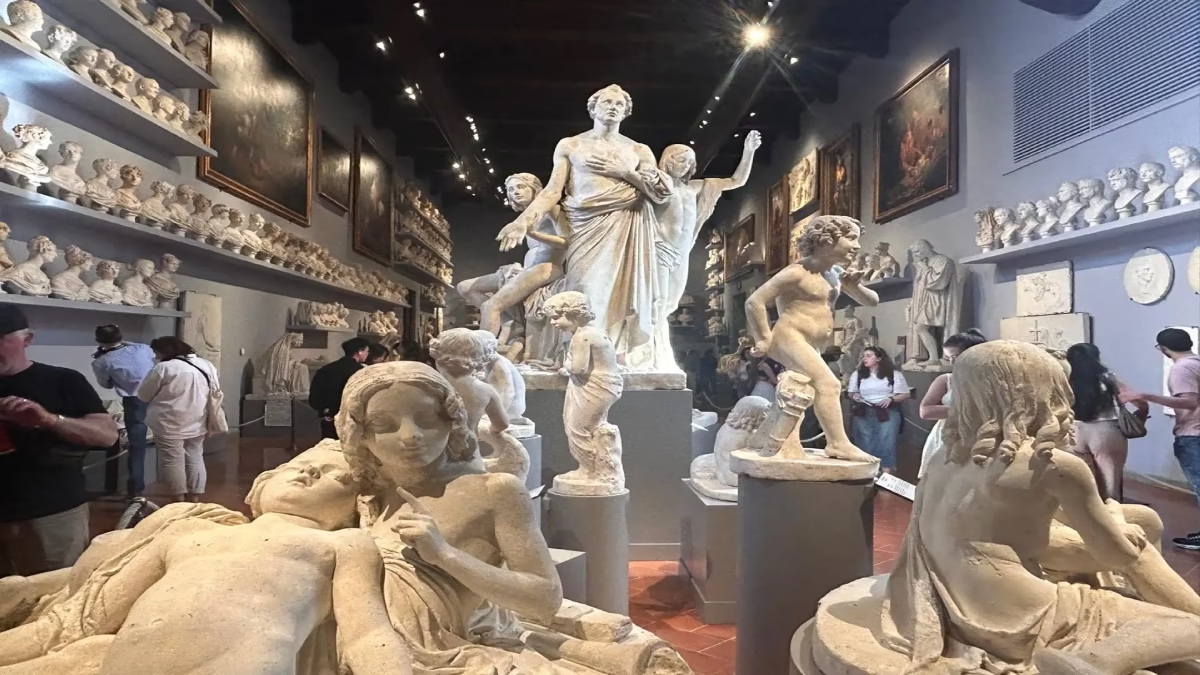
The Accademia Gallery’s ten most essential works span sculpture, painting, and historic instruments: David by Michelangelo, the four Prisoners, St. Matthew, the Palestrina Pietà, Giambologna’s plaster Rape of the Sabines, Pacino di Bonaguida’s Tree of Life, works by Botticelli, the Stradivari tenor viola, Cristofori’s instruments, and the Gabbiani court portraits. All are included in the standard entry ticket.
The Accademia Gallery is not a sprawling encyclopaedic collection — it is a focused museum with a handful of extraordinary works. That focus is its strength. You are unlikely to leave feeling you missed the highlights, which at larger museums is a persistent anxiety. This guide covers the ten works most worth your sustained attention, with specific guidance on what to look for at each.
1. Michelangelo’s David (1501–1504)
Location: Tribune | Time to spend: 20–30 minutes
The primary reason almost two million people visit the Accademia each year. David stands 5.17 metres high in a domed room built specifically for it, under a skylight that changes the quality of the marble’s surface through the day. The statue was carved from a single damaged block of Carrara marble by a 26-year-old Michelangelo over two years and eight months — from a block that two previous sculptors had abandoned.
What to look for: Walk the full circumference before stopping. The contrapposto reads differently from every angle — from behind, the weight through the spine and the disposition of the shoulders tell a different story from the frontal view. Find the stone in the right hand — many visitors miss it entirely. Compare the vein prominence of the raised left hand (blood drained by gravity, veins less prominent) with the right hand bearing the stone’s weight (veins raised and specific). Sit on a bench and look for at least five minutes without photographing.
The head and hands are deliberately oversized — designed for the statue’s originally intended position on a cathedral rooftop 80 metres up, where viewers looking from below would need enlarged features to read the gesture correctly. When the placement changed to ground level, Michelangelo kept the proportions.
Full guide: Michelangelo's David: A Complete Guide
2. The Four Prisoners / Slaves (c. 1519–1534)
Location: Galleria dei Prigioni | Time to spend: 15–20 minutes
Four large unfinished male figures emerging from marble blocks — the Awakening Slave, Young Slave, Bearded Slave, and Atlas Slave — carved for the tomb of Pope Julius II and abandoned when successive revisions of the project made them redundant. Donated to the Medici after Michelangelo’s death, they spent over 300 years decorating a grotto in the Boboli Gardens before reaching the Accademia in 1908.
What to look for: The degree of finish varies dramatically between figures. The Awakening Slave is the least resolved — barely emerged from the block, lying half on its back. The Bearded Slave is the most advanced, but still clearly incomplete at the legs. On each figure, look for the transition between tool stages: the rough point-chisel marks of early mass removal, the finer gradina (toothed chisel) work of intermediate refinement, and the still-smooth patches where final polishing has begun. The Atlas — with the unworked block pressing down on the bowed head — makes the marble itself a participant in the work’s meaning. These are not merely unfinished figures; they are the most direct expression of Michelangelo’s deepest theme: the struggle of form to free itself from matter.
Full guide: The Prisoners (Slaves) by Michelangelo: An In-Depth Look
3. St. Matthew (c. 1503–1505)
Location: Galleria dei Prigioni | Time to spend: 5–10 minutes
Often overlooked between the Prisoners and David, St. Matthew was begun for a planned series of twelve Apostles for Florence Cathedral’s façade and abandoned when Michelangelo was called to Rome. The front of the torso is worked to a level of anatomical precision that rivals the most finished passages of the Prisoners; the rear of the figure remains the raw face of the marble block.
What to look for: The serpentine torsion — the figure twisting in multiple directions simultaneously — anticipates the Mannerist style of later 16th-century Florentine art. Stand to the side and look at both the finished front and the raw back simultaneously. This single figure makes Michelangelo’s carving method more legible than any explanation: he worked from the front face inward, liberating the figure from one surface while leaving the opposite face untouched.
4. Palestrina Pietà (c. 1555, disputed attribution)
Location: Galleria dei Prigioni | Time to spend: 5 minutes
A three-figure Pietà showing the dead Christ supported by the Virgin Mary and a second figure, attributed to Michelangelo since the 18th century but considered by most current scholars to be by another hand — possibly Niccolò Menghini. The Accademia itself describes the attribution as “controversial.”
What to look for: The heavy musculature of Christ’s body is broadly consistent with Michelangelo’s late style; other passages — particularly the heads — are less persuasive as his work. Even if the attribution is uncertain, it is a powerful sculpture in its own right, and the comparison with the confirmed Michelangelo works around it is instructive.
5. Giambologna’s Plaster Rape of the Sabines (1582)
Location: Hall of the Colossus | Time to spend: 10 minutes
The centrepiece of the first room visitors enter — a full-scale plaster model in unfired clay for Giambologna’s marble group that now stands in the Loggia dei Lanzi in Piazza della Signoria. This type of object — a 1:1 working model in the original material of the final composition — is exceptionally rare. Almost no other example from the 16th century survives in this condition.
What to look for: The model shows how Giambologna resolved the compositional problem of three intertwined figures — two male, one female — designed to be readable and dynamic from every angle simultaneously. This was the central formal challenge of late Renaissance sculpture: the figura serpentinata, or serpentine figure, that invites the viewer to walk around rather than stand in front. Compare the plaster here with what you remember of the marble version in the piazza (or photographs of it) — the model has a different surface quality, softer and less resolved, that reveals the thinking process in a way the finished marble suppresses. The work’s title was assigned after completion; Giambologna made the group as a formal exercise in multi-figure composition without a predetermined subject.
6. Pacino di Bonaguida, Tree of Life (early 14th century)
Location: Florentine Gothic Gallery, Room 1 | Time to spend: 10–15 minutes
A large panel painting in the form of a tree — simultaneously the Tree of Life and the Cross of the Crucifixion — its branches filled with circular scenes (roundels) depicting episodes from the Passion and Resurrection of Christ, flanked by figures of Moses, St. Francis, St. Clare, and St. John. A pelican feeding her young with her own blood (a medieval symbol of Christ’s sacrifice) sits above. The programme is a dense typological argument — Old Testament events prefiguring New Testament ones — expressed entirely in visual terms.
What to look for: This is not a painting you read at a glance. Take 10–15 minutes and work through the roundels systematically — the narrative flows from lower left upward through the branches toward the Resurrection scenes at the top. The gold background is not decoration; it represents the divine realm in which these events take place, outside earthly time. The gold-leaf punch work — different tools creating different patterns in the gold surface — is exceptionally fine; look at the variety of textures up close.
7. Botticelli’s Madonnas
Location: Hall of the Colossus | Time to spend: 5–10 minutes
Two smaller devotional Madonna paintings by Sandro Botticelli displayed on the walls of the Hall of the Colossus — less famous than the Birth of Venus and Primavera in the Uffizi but viewable here at eye level in a room that is consistently less crowded than those Uffizi rooms. One of them is the Madonna of the Sea (c. 1477), a domestic Madonna showing the Virgin and Child with a small view of the sea and ships through a window behind them.
What to look for: The tenderness of the mother-child relationship in Botticelli’s Madonna compositions — the physical affection, the meeting of gazes — is a departure from the hieratic formality of the gold-ground paintings in the rooms beyond. Stand close and look at the handling of the Virgin’s veil and the Child’s hands. Then walk to the Gothic Gallery and look at a Maestà from Room 1 — the arc of development between the Byzantine conventions and Botticelli’s domestic naturalism becomes immediately visible.
8. The Stradivari Tenor Viola (1690)
Location: Museum of Musical Instruments, upper floor | Time to spend: 10 minutes
The only surviving Stradivari instrument in entirely original unmodified condition — never repaired with later materials, never adapted for the larger concert halls of the 19th century. The vast majority of known Stradivari instruments have had their necks replaced, their string lengths altered, and their bass bars updated. This viola was never played after the Medici court and was thus preserved exactly as Stradivari built it in 1690, as part of a matched string quintet commissioned by Grand Prince Ferdinando de’ Medici.
What to look for: The instrument is displayed in a case with good lighting. The varnish — a subject of sustained scholarly investigation, with the formula believed by many to contribute significantly to Stradivari’s sound — is visible on the original instrument in a way that photographs cannot fully convey. The neck angle differs from modern instruments because it has not been altered. For anyone who has played a modern string instrument, the proportions feel slightly different.
Full guide: The Museum of Musical Instruments: Florence's Hidden Gem
9. Cristofori’s 1690 Oval Spinet and the Del Mela Upright Piano (1739)
Location: Museum of Musical Instruments, upper floor | Time to spend: 10 minutes
Two instruments that bracket the invention of the piano — Cristofori’s earliest surviving work (the 1690 oval spinet, built for Grand Prince Ferdinando de’ Medici a decade before his piano invention) and the earliest surviving upright piano (1739, by Domenico Del Mela, 40 years after Cristofori’s breakthrough).
What to look for: The comparison between these instruments and the harpsichords displayed alongside them makes the nature of Cristofori’s invention concrete. The harpsichord plucks; the piano strikes. On the multimedia stations nearby, you can hear the sound difference. The spinet’s oval form is extraordinarily rare — almost no other example survives. Del Mela’s upright piano looks more like a cabinet than what most people think of as a piano, making the instrument’s evolutionary path toward the modern form visible.
10. Anton Domenico Gabbiani, Court Musicians of Grand Prince Ferdinando (c. 1685–1690)
Location: Museum of Musical Instruments, upper floor | Time to spend: 5 minutes
A cycle of large paintings by Gabbiani depicting Grand Prince Ferdinando de’ Medici surrounded by the musicians of his court, painted with such fidelity to the instruments and individuals depicted that art historians have been able to identify specific named musicians — Pietro Salvetti, Francesco Veracini — from their likenesses. The instruments visible in the paintings can be matched to instruments in the adjacent cases.
What to look for: The paintings function as both portraiture and document. Ferdinando is shown as a patron who participated in music rather than merely funding it — the compositions show him among musicians rather than above them. The instruments depicted in the paintings include string, wind, and keyboard instruments that demonstrate the full range of the Medici court’s musical resources. Look for the instruments you have just seen in cases appearing as active objects in the hands of musicians.
Practical Notes
All ten works are included in the standard Accademia Gallery entry ticket. The musical instruments section (works 8–10) is on the upper floor and closes at 6:40 pm — 10 minutes before the museum’s main closing time of 6:50 pm.
For the most comfortable viewing of David (work 1) and the Prisoners (work 2), book the 8:15 am opening slot on a weekday. The musical instruments section is consistently quiet at all times of day. The Hall of the Colossus (works 5 and 7) is less crowded than the Tribune but busier than the Gothic Gallery or upper floor.
Allow 90 minutes to see all ten works with reasonable attention. Allow two hours if you want to linger.
Frequently Asked Questions
Why is the Palestrina Pietà included if its attribution is disputed?
The Palestrina Pietà remains central to the Accademia’s collection because it represents an important moment in late Renaissance sculptural thinking, regardless of definitive authorship. Whether carved by Michelangelo or a close follower, it offers profound insight into how Renaissance artists approached religious emotion and physical suffering. Its uncertain status actually invites closer looking—you’re encouraged to wrestle with questions of artistic intention.
How much time should I plan to see the ten masterpieces covered in this guide?
Most visitors spend 1.5 to 2 hours seeing the main works. If you want to linger with David and read the details of each piece carefully, plan 2 to 3 hours. The Accademia’s deliberately focused collection means you won’t feel rushed or overwhelmed by crowds.
What’s special about seeing Giambologna’s plaster cast instead of just viewing the marble version?
The plaster is a study model that reveals the artist’s creative process in raw form—you can see exactly how he worked out the composition. At the Accademia, it’s displayed alongside other Renaissance masterpieces, showing how artistic ideas developed from sketch to finished sculpture. It’s more intimate than the monumental marble, allowing closer viewing.
Are the Stradivari violin and Cristofori pianos actually on display where you can see them?
Yes, both the 1690 Stradivari tenor viola and Cristofori’s early keyboard instruments are on permanent display at the Accademia. They’re housed in dedicated exhibition spaces where you can view them closely—a rare opportunity to see instruments from these legendary makers.
Which piece should I prioritize if I only have an hour?
Start with Michelangelo’s David—it’s the cornerstone. If time allows, see the Four Prisoners next; the two works together tell a complete story about the artist’s vision. Botticelli’s Madonnas are also worth focused attention if you have those final minutes.
Why does an art gallery display violins and pianos alongside sculptures and paintings?
The Accademia celebrates Renaissance craftsmanship across all disciplines—these instruments are masterpieces in their own right, created with the same genius and innovation as the paintings and sculptures. A Stradivari and a Cristofori represent the peak of human skill and artistry, deserving the same reverence as David. Together, they illustrate the full breadth of Renaissance achievement.
