
How Long Does a Visit to the Accademia Gallery Take?
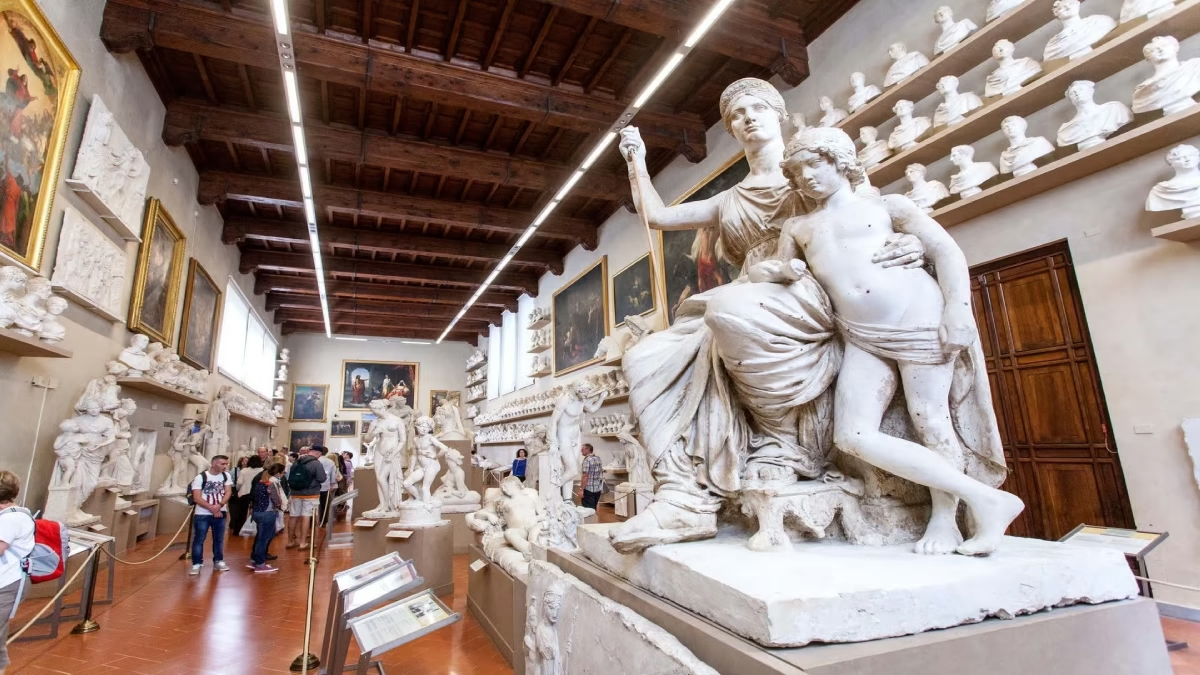
Most visitors spend 60–90 minutes inside the Accademia Gallery. A quick visit focused on David and the Prisoners takes 45–60 minutes. A thorough visit covering the full collection — including the musical instruments, the Byzantine paintings, and the Gipsoteca — takes 90 minutes to 2 hours. There is no time limit once you are inside; you can stay until closing.
The Accademia Gallery is one of the most manageable major museums in Europe. It is compact, focused, and built around a small number of extraordinary works rather than a sprawling encyclopaedic collection. Unlike the Uffizi, where a thorough visit takes half a day, the Accademia can be completed satisfyingly in under two hours — or, if you are there purely for David, in less than an hour.
This article gives you honest time estimates for every type of visit, a room-by-room breakdown, and practical advice for fitting the Accademia into your Florence itinerary.
Time Estimates by Visit Type
By visit type: Quick (David + Prisoners only): 45–60 minutes. Standard (full highlights): 60–90 minutes. Thorough (complete collection): 90 minutes–2 hours. Guided tour: 60–90 minutes guided, then optional extra time. There is no enforced time limit inside the museum.
| Visit Type | Time Required | Best For |
|---|---|---|
| Express — David and Prisoners only | 45–60 minutes | Visitors with limited time or on a tight itinerary |
| Standard — All highlights | 60–90 minutes | Most first-time visitors |
| Thorough — Full collection | 90 min–2 hours | Art enthusiasts, repeat visitors, those with audio guide |
| Guided tour (guided portion) | 60–90 minutes | First-timers who want structured commentary |
| With audio guide (full tracks) | 75–90 minutes | Independent visitors using the official audio guide |
Room-by-Room Time Breakdown
The Accademia’s layout is broadly linear. From the entrance you move through the Hall of the Colossus, down the Galleria dei Prigioni, into the Tribune, and then back through ancillary rooms including the Gipsoteca, the Byzantine and Gothic galleries, and the Museum of Musical Instruments on the upper floor.
Entry and Security (10–20 minutes, outside the museum) The security check is a separate process before you enter the gallery itself. Allow 10–20 minutes during peak season. This time is not spent inside the museum — factor it into your overall Florence scheduling rather than your museum visit time.
Hall of the Colossus (10–15 minutes) The first major room after the entrance. Contains Giambologna’s full-scale plaster model for the Rape of the Sabines, surrounded by significant 15th and 16th century Florentine paintings including works by Botticelli, Ghirlandaio, Filippino Lippi, and Perugino. Most visitors spend 10–15 minutes here. Art enthusiasts spending time with individual paintings may take longer.
Galleria dei Prigioni — Hall of the Prisoners (10–20 minutes) The long corridor leading to David, lined with Michelangelo’s four Prisoners. This is where to slow down. The Prisoners reward close looking — the degree of finish varies between the four figures, and the relationship between the emergent form and the raw marble block is most legible when you stop and spend time with each one. Also contains St. Matthew.
A quick walk-through takes 5 minutes. Giving each Prisoner proper attention takes 15–20 minutes. For visitors using the audio guide, the David commentary begins here and the tracks for the Prisoners add approximately 10 minutes of listening time.
The Tribune — Michelangelo’s David (15–30 minutes) The centrepiece of the visit. Most visitors spend 15–20 minutes in the Tribune. Those who want to walk the full circle around David, contemplate it from different distances and angles, and sit with it for a while typically spend 25–30 minutes. The room is purpose-built with a domed skylight, and the effect of the natural light on the marble changes depending on time of day and weather.
There is no rule about how long you spend here. If you arrive during a quiet period and have the room largely to yourself, there is no reason to leave before you are ready. If it is crowded, moving in and out of the main viewing positions takes patience rather than time.
Gipsoteca Bartolini (5–10 minutes) Adjacent to the Tribune, this room houses 19th century plaster models by Lorenzo Bartolini and his pupils. Often overlooked. Worth a 5–10 minute stop if you are interested in the history of sculpture and workshop practice.
Byzantine and Gothic Painting Galleries (10–20 minutes) Located on the upper floor, these rooms contain the largest collection of gold-ground panel paintings in Italy — over 300 works from the 13th to 15th centuries. This section is frequently bypassed by visitors heading straight to David and back. For anyone with an interest in pre-Renaissance Italian painting, it repays 15–20 minutes of careful attention.
Museum of Musical Instruments (10–20 minutes) Also on the upper floor. Houses rare historic instruments from the Medici court and the Luigi Cherubini Conservatory, including three Stradivarius pieces and the Cristofori fortepiano of 1700 — the oldest surviving piano in the world. This section is consistently undervisited, even on busy days. A focused visit takes 10–15 minutes. Visitors who engage with the instruments in detail and listen to any available recordings typically spend 20 minutes.
How the Total Time Adds Up
For a standard visit covering the Hall of the Colossus (12 min), Prisoners corridor (15 min), Tribune/David (20 min), Gipsoteca (5 min), and a brief look at the Byzantine galleries (10 min): approximately 62 minutes inside the museum.
For a thorough visit adding meaningful time with each Prisoner (20 min), extended time with David (25 min), the full Byzantine and Gothic galleries (20 min), and the musical instruments (15 min): approximately 90–100 minutes.
Both estimates are without an audio guide. With the official audio guide and all tracks, add 15–20 minutes across the full visit.
Is There a Time Limit Inside?
No. Once inside the Accademia Gallery, there is no time restriction on how long you spend. You can remain until the museum closes at 6:50 pm (ground floor access ends at 6:40 pm for the Musical Instruments rooms and upper floor).
Your timed entry ticket governs when you arrive, not how long you stay. A 9:00 am entry ticket does not expire at 10:30 am — you are free to stay for the rest of the day if you choose.
How to Plan the Accademia into Your Florence Day
Accademia only (morning): Arrive at 8:15 am, spend 60–90 minutes inside, exit by 9:45–10:00 am. Leaves your morning free for the Duomo, Bargello, or San Marco before lunch.
Accademia + Uffizi (same day): This is the most popular combination. The recommended sequence is Accademia first (8:15–9:45 am), short coffee break, then Uffizi from 11:00 am or 11:30 am. Allow 2–3 hours for the Uffizi. Total museum time: 3–4.5 hours. Comfortable in a full day, tiring but doable. See our Accademia + Uffizi combo guide.
Accademia + Duomo (same day): Accademia in the morning (8:15–9:45 am), walk to the Cathedral Square (10 minutes), Duomo exterior and Baptistery (45–60 minutes), optional Dome climb (1 hour). Total: 3–4 hours. See our Accademia + Duomo tour guide.
Accademia + Bargello (new 2026 combined ticket): The Accademia and Bargello are a 12-minute walk apart and together make an extraordinary Michelangelo sculpture day — David and the Prisoners at the Accademia, then Donatello’s bronze David and Michelangelo’s early Bacchus at the Bargello. Allow 90 minutes for the Accademia and 90 minutes for the Bargello. The new 2026 combined ticket (€26, valid 48 hours) covers both. See our Accademia Gallery Tickets guide.
Practical Information
Museum opens: 8:15 am Tuesday to Sunday Last entry: 6:20 pm Museum closes: 6:50 pm (ground floor Musical Instruments rooms and upper floor accessible until 6:40 pm) Closed: Every Monday, 1 January, 1 May, 25 December
For complete opening hours including seasonal variations, see our opening hours guide.
Frequently Asked Questions
Is 1 hour enough for the Accademia Gallery?
Yes — 60 minutes is sufficient to see the main highlights: Hall of the Colossus, the Prisoners corridor, and David. You will not have time to explore the musical instruments or Byzantine galleries in depth, but you will see the essential works without rushing.
Is 2 hours too long for the Accademia Gallery?
Not if you engage with the collection fully — the musical instruments section alone merits 15–20 minutes, and the Byzantine painting galleries are genuinely excellent. Two hours is comfortable for a thorough visit. It may feel long if your only interest is David.
Do guided tours last longer than self-guided visits?
The guided portion of a standard group tour runs 60–90 minutes and covers the main highlights efficiently. After the guided section, you are free to continue exploring independently. Total time inside the museum is often similar to a self-guided visit.
Can I come back inside after exiting?
No. Re-entry is not permitted once you exit. If you are planning a long visit, do not leave for lunch and expect to return on the same ticket.
Can I visit the Accademia and the Uffizi in one day?
Yes, and many visitors do. Allow at least 90 minutes at the Accademia and 2–3 hours at the Uffizi, with time between. See our Accademia + Uffizi combo guide for a suggested schedule. —
