
Byzantine & Gothic Art at the Accademia: A Visitor's Guide
The Accademia Gallery holds one of the largest collections of gold-ground panel paintings in Italy — over 300 works from the 13th to early 15th centuries, displayed in rooms on the ground floor (Florentine Gothic Gallery) and the upper floor. Works include pieces by Giotto, Bernardo Daddi, the Orcagna brothers, Pacino di Bonaguida, and Lorenzo Monaco. This section is almost always less crowded than the Michelangelo rooms and rewards visitors who give it time.
Nearly every visitor to the Accademia Gallery spends the majority of their time in the Tribune with David and the Galleria dei Prigioni with the Prisoners. The painting galleries — particularly the Byzantine and Gothic rooms — are walked through quickly or bypassed entirely. This is understandable: most people come for Michelangelo’s sculpture, and the gold-ground panels of the 13th and 14th centuries are an acquired taste.
But these rooms contain something worth understanding: the moment in Western art history when painting began to change from a flat, symbolic, spiritual idiom into a spatial, emotional, naturalistic one. The painting that would eventually become the Uffizi’s Botticelli and Leonardo started here, in these Byzantine gold grounds and Giotto’s tentative spatial experiments.
What Is Byzantine and Gothic Art?
Byzantine art refers to the artistic tradition of the Eastern Roman (Byzantine) Empire, centred on Constantinople (modern Istanbul). Its visual language dominated religious painting in Italy from roughly the 6th through the 13th centuries: elongated, flat figures with formal gestures and stylised drapery; gold backgrounds representing divine light rather than physical space; hieratic compositions where size indicated importance (Christ larger than saints, saints larger than mortals) rather than spatial logic. The figures look at you frontally, across a flat picture plane, from a realm outside ordinary time.
Gothic art describes the artistic movement in Western Europe — roughly 12th to 15th centuries — that developed alongside Gothic architecture. In Italian painting, the Gothic style modified the Byzantine tradition: figures became more three-dimensional, drapery began to suggest the body beneath it, emotional expression appeared in faces, and compositions became more narrative. In Florence particularly, the transition from Byzantine to Gothic to Renaissance painting is the central drama of Western art history — the story of how flat, symbolic, devotional art became spatially convincing, emotionally direct, and humanist over approximately 150 years.
Most of the works in the Accademia’s Byzantine and Gothic section came into the collection when Napoleon suppressed religious institutions across Italy in the early 19th century, and Florentine churches and convents were dissolved. Their altarpieces and devotional panels — which had been in situ for centuries — were moved to the Accademia for preservation. This gives the collection its character: it is not a curated anthology of the period’s greatest works, but a genuine survival of Florentine religious painting from the churches and monasteries of a specific city.
The Collection: Room by Room
Florentine Gothic Gallery (Ground Floor, Three Rooms)
The Florentine Gothic Gallery occupies three rooms at the far end of the ground floor, past the Gipsoteca. The rooms are organised roughly chronologically, tracing the development of Florentine painting across the 13th and 14th centuries.
Room 1 — 13th and Early 14th Century: The Byzantine Foundation This room contains the oldest works in the Accademia’s painting collection — the nucleus of what was transferred from suppressed Florentine institutions in the early 19th century. The principal types of work here are: painted crosses (large crucifixes that hung above church altars, showing Christ in the Byzantine manner); Maestà compositions (the enthroned Virgin and Child, usually at large scale for side altars); triptychs and polyptychs (multi-panel altarpieces); and scenes from the lives of saints.
The visual language is consistent: gold backgrounds, flat forms, stylised drapery, frontal figures, and an emphasis on spiritual hierarchy over spatial plausibility. Christ or the Virgin fills the centre; saints are arranged symmetrically on the sides. The figures are present as icons — objects of devotion rather than characters in a narrative.
Key work: Pacino di Bonaguida, Tree of Life (early 14th century) One of the most extraordinary objects in the Accademia collection and among the rarest surviving examples of its type. A large panel painting in the form of a tree — the Tree of Life from Genesis, simultaneously the Cross of the Crucifixion, its branches filled with small circular scenes (roundels) illustrating episodes from the life, Passion, and Resurrection of Christ. The programme is deeply complex: above, a pelican feeds her young with her own blood (a medieval symbol of Christ’s sacrifice); at the base, scenes from Genesis and figures of Moses, St. Francis, St. Clare, and St. John. The whole functions as a visual theological argument rather than a narrative or a portrait. Looking at it carefully is an act of reading as much as seeing.
Room 2 — The Giottesque Painters This room is organised around the legacy of Giotto di Bondone (c. 1267–1337), the Florentine painter who more than any other figure initiated the transition from Byzantine flatness toward naturalistic representation. The room’s only work actually by Giotto is a fragment of a detached fresco from the Badia Fiorentina (Florence’s oldest abbey), showing a shepherd’s head from approximately the 1320s. Small, detached, easily overlooked — but the quality of the observation in a single face is immediately distinguishable from the stylised heads in Room 1.
Around the Giotto fragment are works by his pupils and followers, particularly Bernardo Daddi (c. 1290–1348), one of the leading Florentine painters of the generation after Giotto. Daddi’s large painted Crucifix from the Florentine church of San Donato in Polverosa is displayed here — the “Christus patiens” type, showing the suffering Christ rather than the triumphant one, the body beginning to exhibit weight and physical suffering in ways the pure Byzantine tradition did not accommodate.
The Giottesque painters did not abandon gold grounds or hierarchical composition overnight. What they introduced was gradual and limited: figures that show emotion in their faces, bodies that have weight rather than floating against the gold, drapery that falls with some suggestion of what lies beneath. The change is most visible not from the front but in comparison — look at Daddi’s work alongside Room 1, and the decades of development become apparent.
Room 3 — The Orcagna Brothers and Their Followers The final room of the Florentine Gothic Gallery takes its name from the brothers of the di Cione family: Andrea (nicknamed “Orcagna”), Nardo, Matteo, and Jacopo. Andrea di Cione was one of the dominant artistic figures in mid-14th-century Florence — active as both painter and sculptor, running a prosperous workshop that completed major commissions for Florentine churches and guilds.
The principal work here is the Pentecost triptych (c. 1365), originally made for the high altar of the Church of Santi Apostoli in Florence. The composition shows the moment when the Holy Spirit descends on the Apostles and the Virgin Mary as tongues of fire — a monumental standing Madonna dominates the central panel, surrounded by kneeling Apostles and witnessing angels. The lost Gothic cusps (the pointed upper extensions that originally framed the panels) would have given the triptych a soaring vertical emphasis now absent; even without them, the hierarchical organisation and precision of the gold work are exceptional.
The Orcagna brothers used precious gold leaf for fabric and drapery decoration with particular refinement — different punches create textural patterns in the gold that catch light differently depending on viewing angle. This is craftsmanship as theology: the richness of the materials embodied the spiritual importance of the subject.
Upper Floor: Florentine Painting 1370–1420
A separate section on the upper floor (accessible by lift or stairs) is dedicated to Florentine paintings from approximately 1370 to 1420 — the transitional period between the Orcagna generation and the fully developed early Renaissance. This section has a notably calm atmosphere — smaller rooms, natural light from upper windows, and very few visitors even on busy days.
Notable here are works by Lorenzo Monaco (c. 1370–c. 1425), a Camaldolese monk and painter who was among the most technically accomplished Florentine painters of his generation. Lorenzo Monaco occupies a complex position in art history — his work has deeply Gothic formal qualities (elongated figures, flame-like drapery, richly gold-laden compositions) but with a lyrical elegance and technical refinement that looks forward rather than backward. His treatment of light within gold grounds, and the emotional expressiveness of his Madonnas, anticipates the Renaissance without belonging to it.
The upper floor also includes examples of altarpieces from Florentine guilds — civic commissions that document both the social history of patronage and the range of iconographic programmes that different institutional patrons required from their painters.
The 15th-Century Painting Galleries (Hall of the Colossus and adjacent rooms)
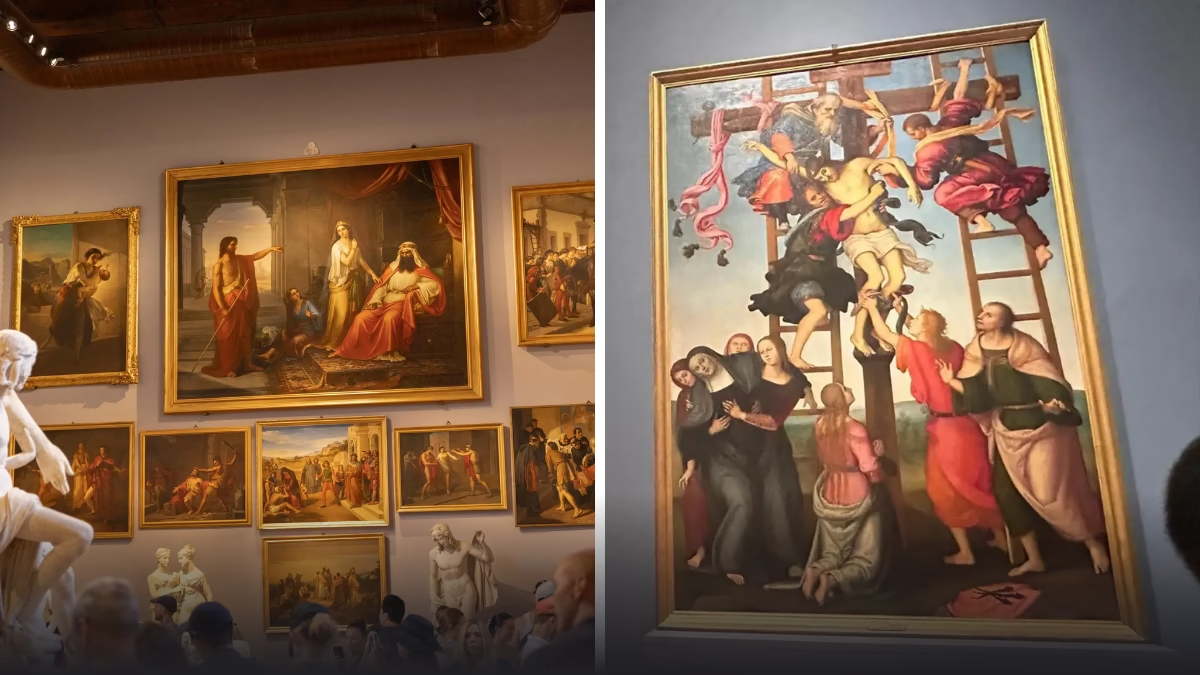
The Hall of the Colossus — the first major room visitors enter — contains a selection of early 15th and early 16th-century Florentine paintings that technically belong to the Renaissance period but are displayed alongside earlier work. This includes pieces by Sandro Botticelli, Domenico Ghirlandaio, Filippino Lippi, Paolo Uccello, and Perugino. These are paintings that would be headline works in a lesser museum; at the Accademia they are overshadowed by the Michelangelo sculpture, which means they are consistently viewable without crowding.
Botticelli’s two Madonnas here — smaller and less famous than the Birth of Venus and Primavera in the Uffizi — are worth stopping for. The transition from the gold-ground panels of Room 1 to Botticelli’s domestic Madonnas in the Hall of the Colossus is one of the great before-and-after moments available in any museum: approximately 150 years of artistic development, visible in adjacent rooms.
What to Look For: Practical Guidance for Visitors
The gold backgrounds as theological argument. Gold in medieval and early Renaissance painting is not decoration — it represents divine light, the realm of the sacred, a space outside earthly time. When you look at a gold-ground altarpiece, you are not meant to read the gold as a backdrop but as the substance of the spiritual world in which the figures exist. The transition from gold backgrounds to the blue skies and spatial depth of the Renaissance is one of the most significant conceptual shifts in the history of art.
The punch work on gold leaf. Look closely at the gold backgrounds in the Orcagna room — the surface is not flat but textured, impressed with patterns using tools called punches. Different punches create different geometric patterns (crosshatching, circles, stars, flowing curves) in the gilded surface. In candlelight — the original viewing condition for almost all of these works — the textured gold shimmered and shifted as flame moved. The effect we see in fluorescent museum lighting is a diminished version of the original visual experience.
Giotto’s shepherd fragment vs. Room 1. Even in its damaged, fragmentary state, the Giotto shepherd’s head in Room 2 shows a degree of individualised observation — the specific features of a face that might belong to a recognisable person — absent from the stylised faces of the Room 1 Byzantine works. This is the beginning of the long road to Rembrandt and Caravaggio.
The Tree of Life by Pacino di Bonaguida. This single work rewards 15–20 minutes of concentrated attention. The theological programme is dense and deliberate — every roundel tells a specific story, and the relationship between stories follows a complex typological logic (Old Testament events prefiguring New Testament ones). A docent or audio guide commentary on this work alone is worth having.
The transition to the Hall of the Colossus. Walking from the Gothic Gallery rooms into the Hall of the Colossus — where the early Renaissance paintings are displayed around Giambologna’s plaster Rape of the Sabines — makes the art historical transition concrete. The gold grounds give way to blue skies; the hieratic figures give way to individuals with weight and psychological complexity. The contrast is the argument.
Why This Section Matters
The Accademia’s Byzantine and Gothic collection is not a consolation prize for visitors who would rather be at the Uffizi. It is the context without which the Uffizi’s paintings float free of history. Botticelli’s Venus emerged from the tradition that produced Pacino di Bonaguida’s Tree of Life. Leonardo’s spatial revolution became possible only because Giotto first suggested that figures might exist in something like real space. The gold grounds did not fail — they were replaced by something that used what they had developed and pushed further.
Most visitors to Florence see the Renaissance masterworks without ever seeing what came before them. The Accademia’s painting galleries offer that before — quietly, with almost no crowds, in rooms that reward slow looking.
Frequently Asked Questions
Where is the Byzantine and Gothic painting collection in the Accademia?
The Florentine Gothic Gallery occupies three rooms at the end of the ground floor, past the Gipsoteca Bartolini. An additional section of transitional paintings (1370–1420) is on the upper floor, accessible by lift or stairs.
Who are the main artists in the Gothic painting collection?
The most significant names are Giotto (represented by a fresco fragment), Bernardo Daddi, the Orcagna brothers (Andrea di Cione and family), Pacino di Bonaguida, and Lorenzo Monaco. The Hall of the Colossus contains later works by Botticelli, Ghirlandaio, Filippino Lippi, Perugino, and Paolo Uccello.
Do I need art history knowledge to appreciate this section?
No — but even a brief introduction to what Byzantine flat gold-ground painting is, and how Giotto began to change it, makes the collection dramatically more interesting. The contrast between the styles is viscerally visible without any prior knowledge.
Is the Byzantine and Gothic section included in the standard ticket?
Yes — fully included in the standard Accademia Gallery entry ticket at no additional charge. —
